
Updated September 2026. This post answers whether SEO still matters now that AI engines write answers, and how SEO and GEO fit together in practice.
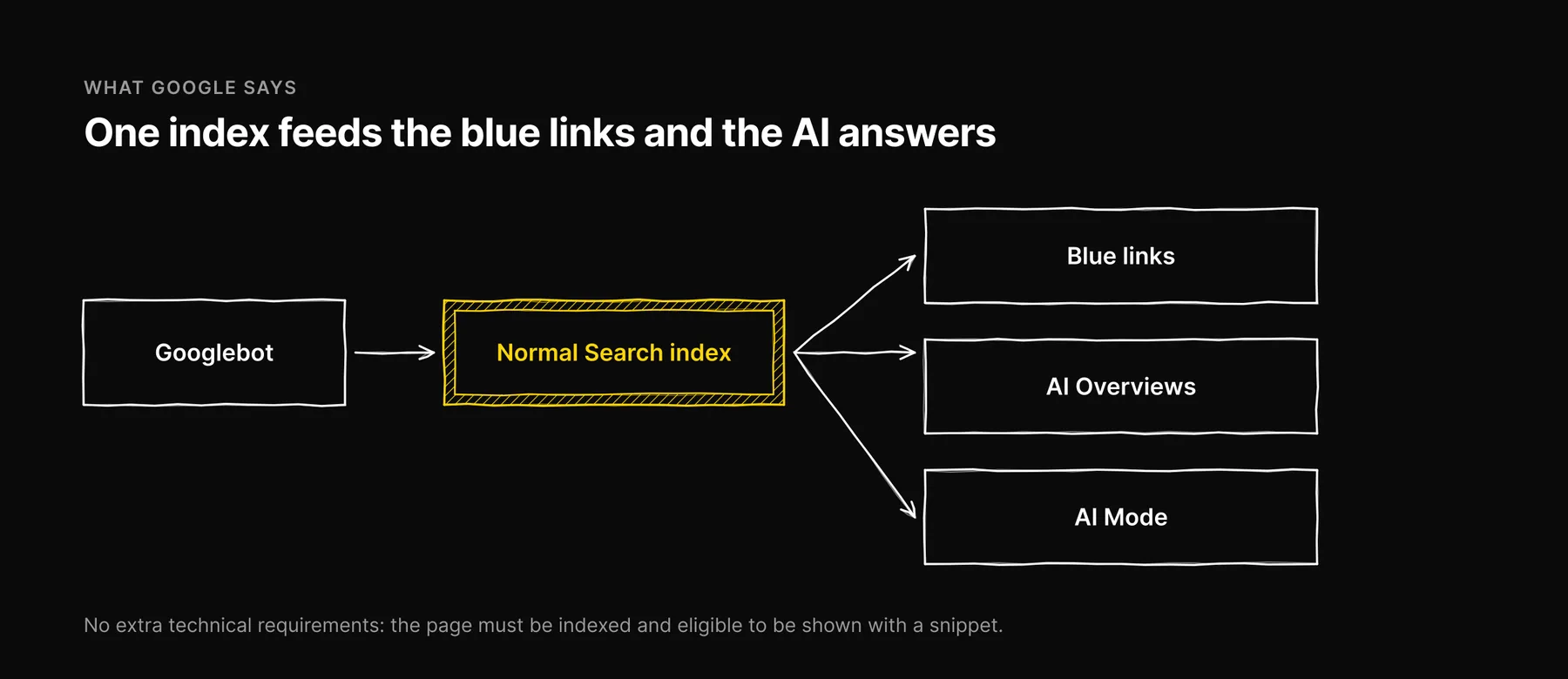
Yes, SEO still matters, and the clearest evidence comes from the search engines themselves. Google says its AI Overviews and AI Mode are built from the normal Search index, under the normal eligibility rules. ChatGPT, Claude and Perplexity answer from pages their own search crawlers have indexed. A page that can't be crawled, indexed and trusted is unlikely to be cited by any of them. GEO (generative engine optimization) is extra work built on that base.
What Google actually says about AI Overviews
The strongest case for SEO comes from Google's own documentation on AI features and your website. Paraphrasing its main points:
- AI Overviews and AI Mode are Search features. They draw on Google's normal index, crawled by Googlebot.
- There are no extra technical requirements to appear in them. A page has to be indexed and eligible to be shown in Search with a snippet.
- The usual SEO best practices still apply.
- Snippet controls such as
nosnippetandmax-snippetalso limit what can be shown in these AI features. - Traffic from these features is reported inside Search Console's normal Performance report, under the Web search type, not in a separate AI report.
Two consequences are worth spelling out. There is no special "AI Overview markup" to add. And Google-Extended, the robots.txt token many sites have heard about, does not affect inclusion in Search or AI Overviews. According to Google's crawler documentation, it controls whether your content is used for Gemini model training and grounding.
So on Google, AI answers draw from the same index, the same crawler and the same eligibility rules as the blue links. The work that earns a page its place in that index is SEO.
The other engines rely on search too
Outside Google, the pattern is similar, even if the index belongs to someone else:
- ChatGPT search, launched in October 2024, draws on OpenAI's own index built by
OAI-SearchBot, plus third-party search providers. Bing has been one of those providers. - Claude has had web search since 2025, and Anthropic runs
Claude-SearchBot, which crawls pages to improve Claude's search results. - Perplexity indexes the web with
PerplexityBot. - Gemini can ground its answers in Google Search results.
Each of those crawlers has to reach your pages, read them and decide they are worth keeping. Crawl access, clean HTML, sensible internal linking, fast and stable pages and clear topical focus are what technical and on-page SEO have always been about. They now serve several indexes instead of one.
The one place that search matters less is a model's training data, the knowledge built in before release. You can't optimize that directly or on any schedule you control.
Where GEO adds work that SEO doesn't cover
If SEO is the entry ticket, GEO is about what happens once the engine has your page and several competitors' pages in hand and has to write one answer. We see four areas where the work differs.
1. The answer might not link to you
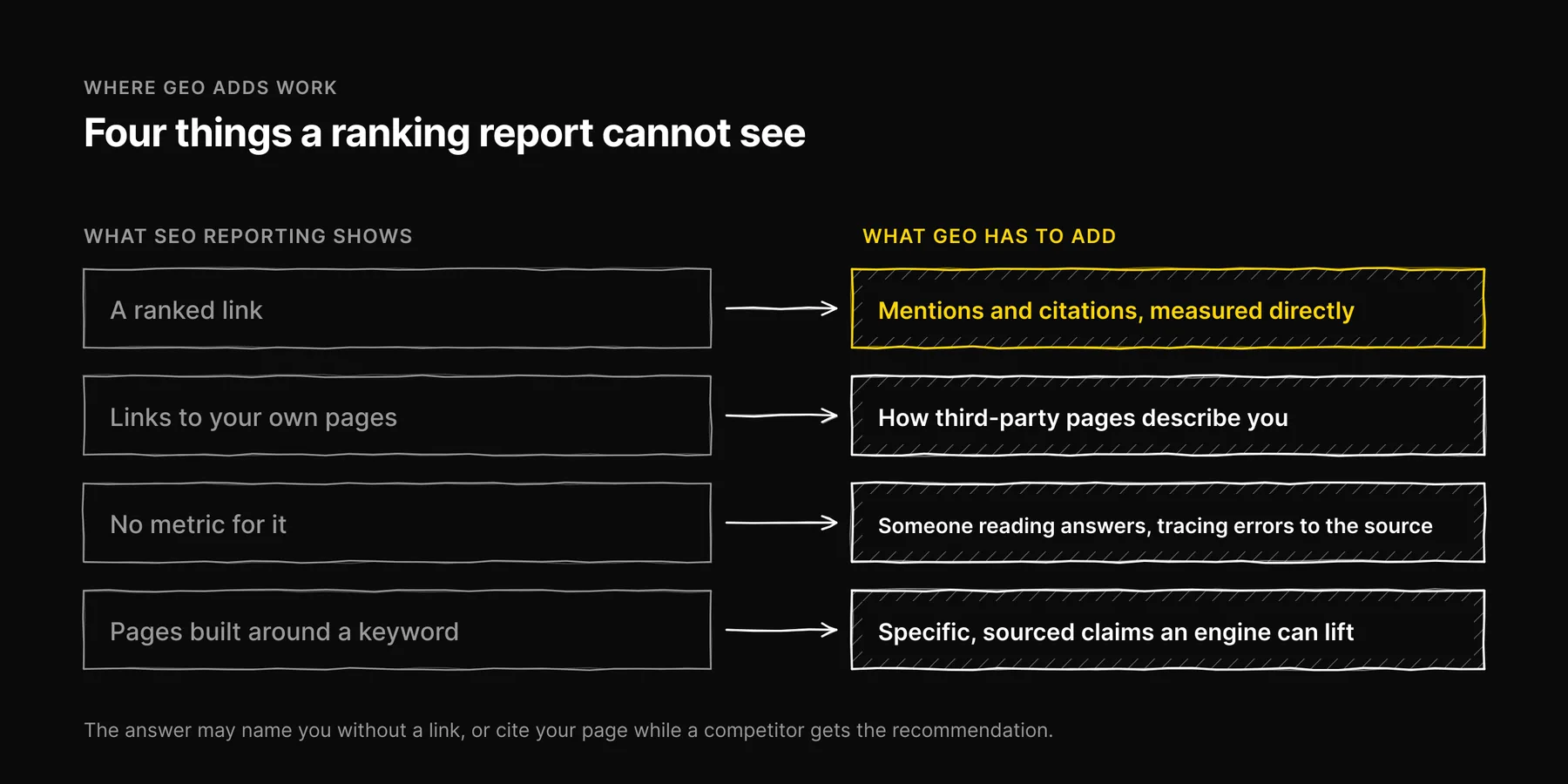
In classic search, success means a ranked link. In a generated answer, your brand can be named with no link, or your page can be cited as a source while a competitor gets the recommendation. SEO reporting sees neither. You need to measure mentions and citations directly.
2. Third-party pages carry more weight
For "best X for Y" questions, engines often cite review sites, comparison articles, forums such as Reddit and trade press. Your standing on pages you don't own shapes the answer. Classic link building helps here, because the same pages that link to you are often the pages being cited. The goal widens from "get a link" to "be described accurately where buyers and engines look".
3. Accuracy becomes a metric
An engine can summarize you wrongly: an old price, a discontinued product, a confused brand name. SEO has no metric for that. GEO has to include someone reading the answers and tracing errors back to the page or listing that caused them.
4. Content has to be quotable
Good SEO content and good GEO content overlap, but generative engines reward pages that make specific, sourced claims they can lift. The GEO research paper found that adding citations, quotations and statistics raised a source's visibility on its benchmark, while keyword stuffing did not. That favors clear answers under clear headings over long pages built around a keyword. Our post on what gets content cited goes deeper.
For a fuller definition of GEO and where the term comes from, see what GEO is.
Which query types change most
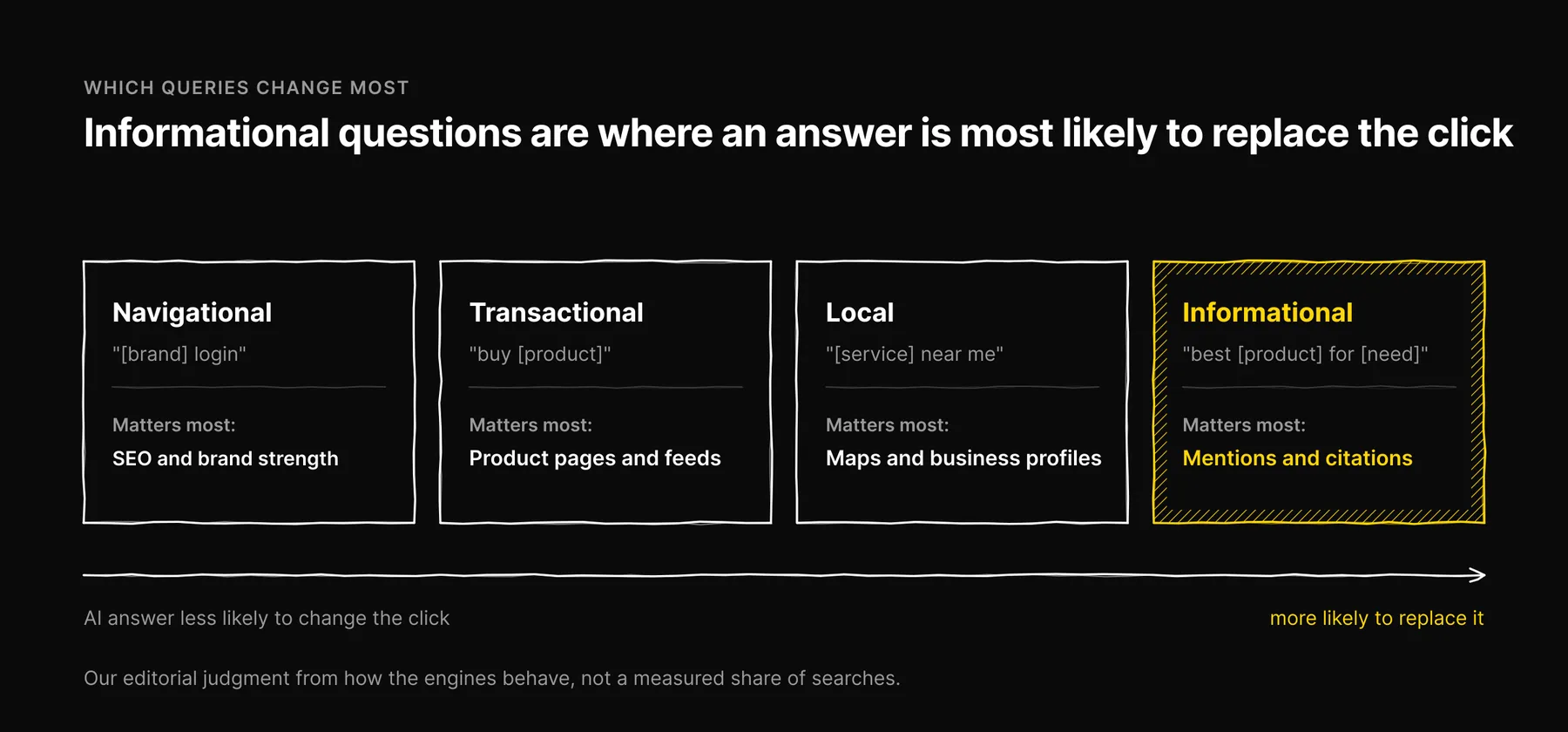
AI answers don't affect every query the same way. We don't know of a reliable public figure for how searches split between these types, or how fast the split is moving, so we won't quote one. The pattern below is our editorial judgment from how the engines behave, not a measured share.
- Navigational ("[brand] login"): the user wants a specific site. An AI summary adds little. Classic SEO and brand strength decide this.
- Transactional ("buy [product]"): shopping results, product pages and merchant listings still do most of the work. Product-page SEO and feeds matter most.
- Local ("[service] near me"): maps and business profiles lead. Consistent business details matter for both classic and AI results.
- Informational and research ("how to choose [product]", "best [product] for [need]"): this is where a generated answer is most likely to replace a click, and where being mentioned and cited matters most.
To see how this plays out for your own site, look at your own data. In Search Console, watch whether impressions hold while clicks fall on informational queries. Then check whether your brand is mentioned in the AI answers to those same questions. In Ezeo we put Search Console data and our weekly AI scans side by side for exactly this reason.
How to decide where to put effort
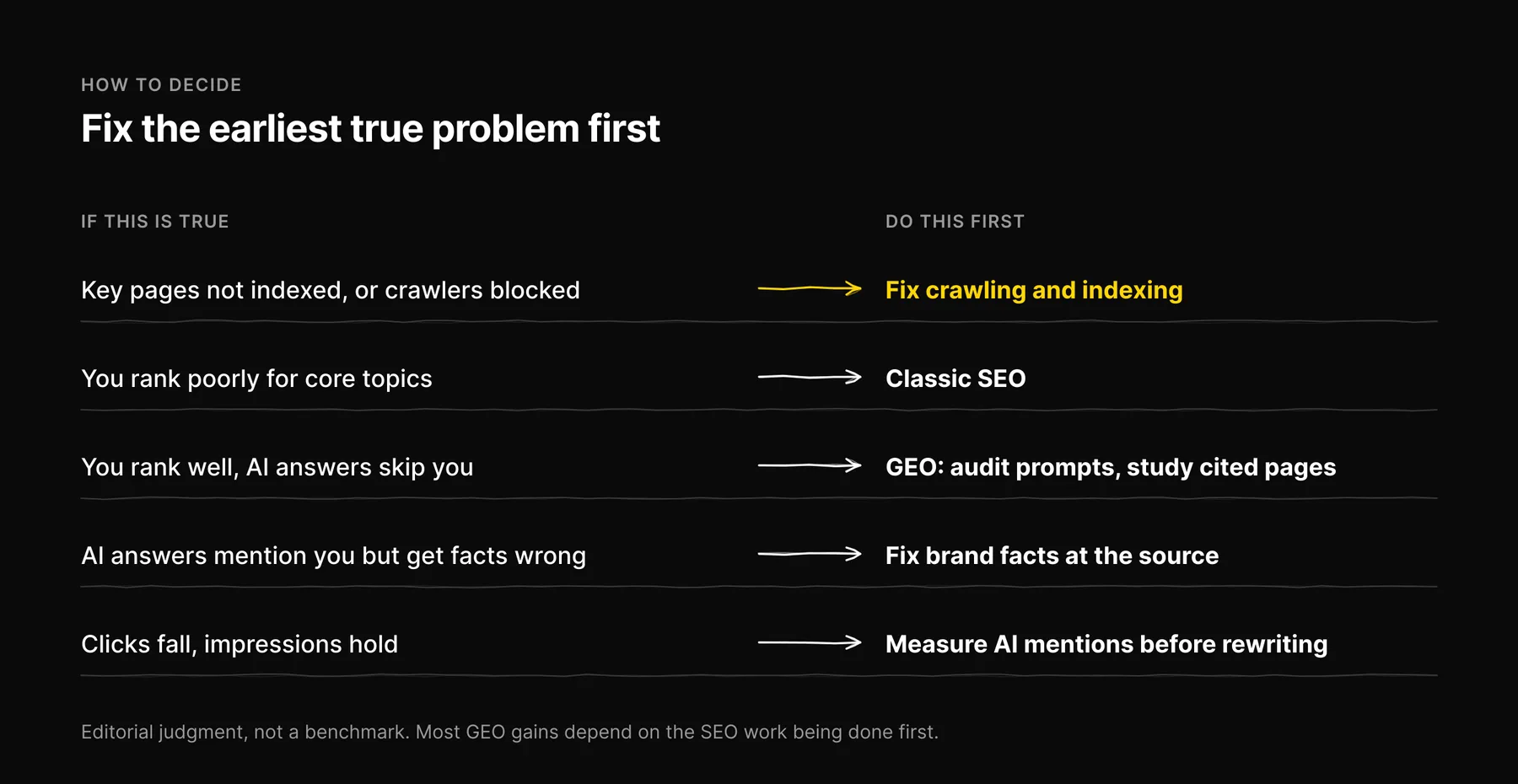
A budget split by percentage misses the point. Most GEO gains depend on SEO work being done first, so the useful question is what to do first.
Here is the decision guide we use. It is editorial judgment, not a benchmark:
| If this is true | Do this first |
|---|---|
| Key pages aren't indexed, or crawlers are blocked | Fix crawling and indexing. Nothing else works until this does. |
| You rank poorly for your core topics | Classic SEO: content that answers the query, internal links, technical health. |
| You rank well, but AI answers don't mention you | GEO: audit the prompts, study which pages get cited for competitors, build or earn those pages. |
| AI answers mention you but get facts wrong | Fix brand facts at the source: your site, profiles, listings and the third-party pages being cited. |
| Clicks fall on informational queries while impressions hold | Measure AI mentions for those queries before rewriting pages, so you know what you're fixing. |
One trade-off to be honest about: GEO work is harder to attribute than SEO work. A ranking change shows up in Search Console with a date attached. A new mention in ChatGPT might come from your page, from a review site that cited you, or from the engine simply answering differently that week. That is why we keep the prompt set fixed and log cited URLs, not only mentions. The cited URL is the closest thing to a cause you can see. It is also why we fix a crawl or indexing problem before starting any GEO project: that fix is measurable on both sides.
Do backlinks still matter?
Yes, for the same reason SEO does. Links help crawlers discover pages and help search systems judge which pages to trust, and those same search systems feed the AI answers. What changes is how you judge a link. In our view, a mention on a page that engines actually cite for your category is worth more to GEO than a link on a page nobody reads. If you're pulling link data yourself, our note on how we source backlink data covers one lesson worth knowing first: when your data source changes, a jump in link count may reflect wider coverage, not new links.
What to measure, side by side
Track both sets, from the same pages and queries where you can:
- SEO: indexed pages, rankings, impressions, clicks, organic conversions.
- GEO: brand mentions per engine, cited URLs, accuracy of descriptions, share of voice against named competitors, referral sessions from AI engines.
Keep one rule for both: "not measured" is not zero. If an engine or a query wasn't checked in a given week, record a gap, not a 0. Otherwise a failed check shows up as a drop in visibility.
Practical next steps
- Check the base. Confirm your key pages are indexed in Google and Bing, eligible for snippets, and reachable by
OAI-SearchBot,Claude-SearchBotandPerplexityBot. - Take an AI baseline. Run a fixed set of customer questions across the engines, repeat each more than once, and record mentions and citations. Our AI visibility audit guide walks through it.
- Fix in order. Crawling, then ranking, then citations, then accuracy, using the decision guide above.
- Follow the full checklist. Our AI visibility optimization checklist covers the rest step by step.
What changed in the September 2026 update: The file is llms.txt, not llm.txt, and Ezeo tracks five AI engines, not six. The budget-split table and the claims about search's share of web traffic, which had no source, are removed.
Frequently asked questions

Written by
Jose Antonio Mijares
SEO & GEO Expert | Founder at Ezeo