
Updated September 2026. This post sets out what public evidence says makes a page more likely to be cited in AI-generated answers, where that evidence stops, and how we check our own content against it.
No AI engine publishes its citation criteria, so anyone who hands you a precise ranking of "AI quality signals" is guessing. The best public evidence points one way: pages that include citations to sources, quotations from relevant people and specific statistics were more visible in generative engine answers in controlled experiments, while keyword stuffing did not help. Google's guidance for its AI features adds that there are no special requirements beyond normal Search. Write helpful, people-first pages, make sure they can be crawled and shown with a snippet, and make every claim specific enough to quote.
Below we keep three things apart: what research measured, what Google has said in its own documentation, and what is our editorial judgment. Each section says which one it is.
The evidence: what the GEO research measured
The term "generative engine optimization" comes from a research paper, "GEO: Generative Engine Optimization" by Aggarwal and colleagues from Princeton and other institutions. It was posted to arXiv in November 2023 and published at KDD 2024. The authors built a benchmark of queries, rewrote source pages using different methods, and measured how visible each source became in the answers a generative engine produced.
The findings that matter for writers:
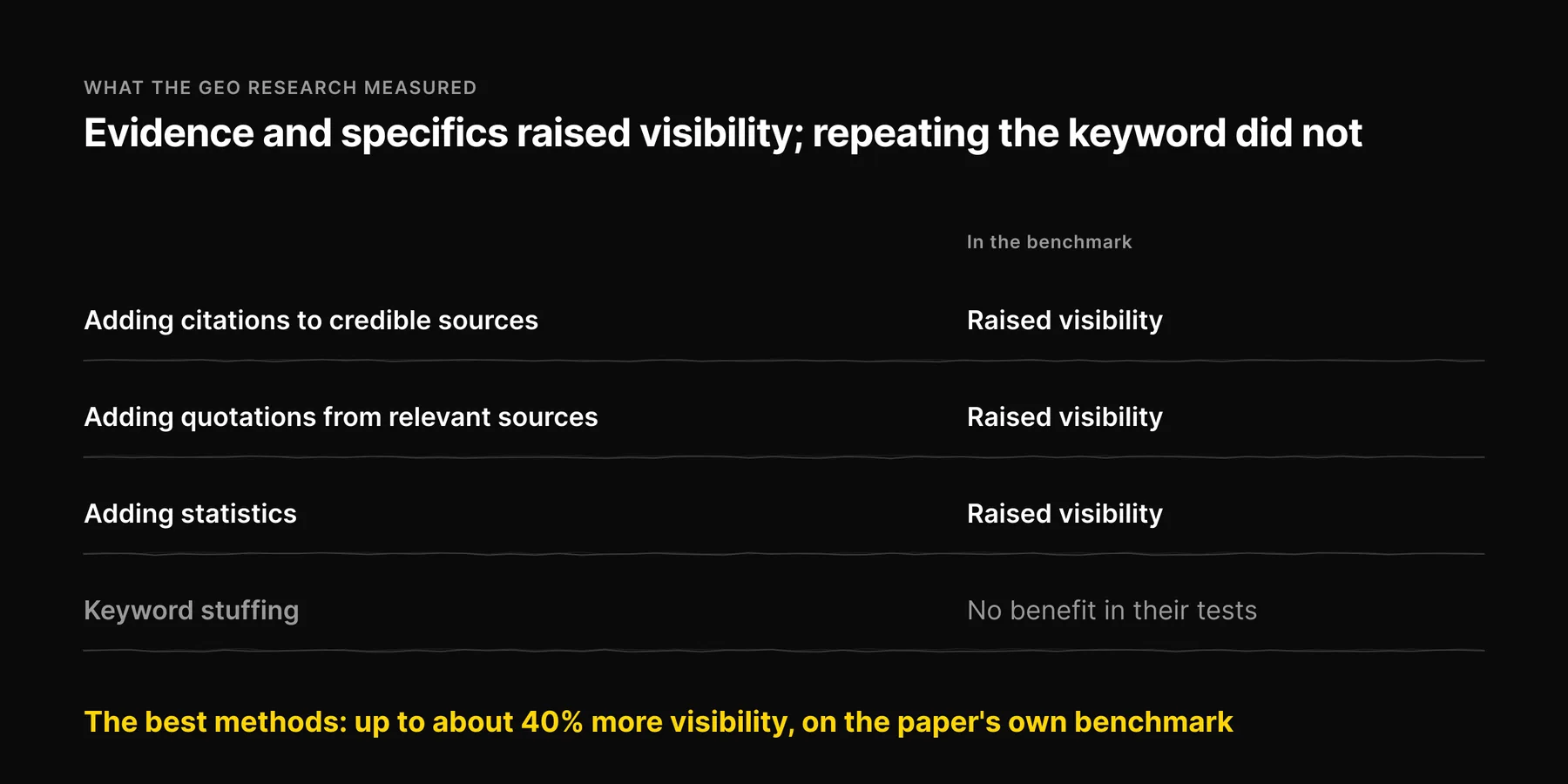
- Adding citations to credible sources raised a page's visibility.
- Adding quotations from relevant sources raised it.
- Adding statistics raised it. The best methods improved visibility by up to about 40% on their benchmark.
- Keyword stuffing did not help. The old SEO habit of repeating the target phrase carried no benefit in their tests.
Read that as a benchmark result, not a law. The experiments used the authors' own setup, and the production engines people use today have changed since. What the paper gives you is direction: evidence and specifics help a source get used, and repetition does not. For the wider background on GEO as a discipline, see our explainer on what GEO is.
The documentation: what Google says about its AI features
Google publishes guidance on AI features and your website, covering AI Overviews and AI Mode. The points that matter here:
- There are no extra requirements. To appear as a supporting link, a page must be indexed and eligible to be shown in Search with a snippet. The same fundamentals apply as for any Search result.
- Snippet controls apply.
nosnippetandmax-snippetlimit what Google can show, including in AI features. - Helpful, people-first content is the standard. Google points site owners to its usual guidance on content made to help people rather than to rank.
One common misreading is worth correcting. Google-Extended is a robots.txt token that controls whether your content is used for Gemini model training and grounding. Google's crawler documentation is clear that it does not affect inclusion in Google Search or AI Overviews. Allowing it will not get you into an AI Overview, and blocking it will not take you out.
Before quality: can the engine reach the page?
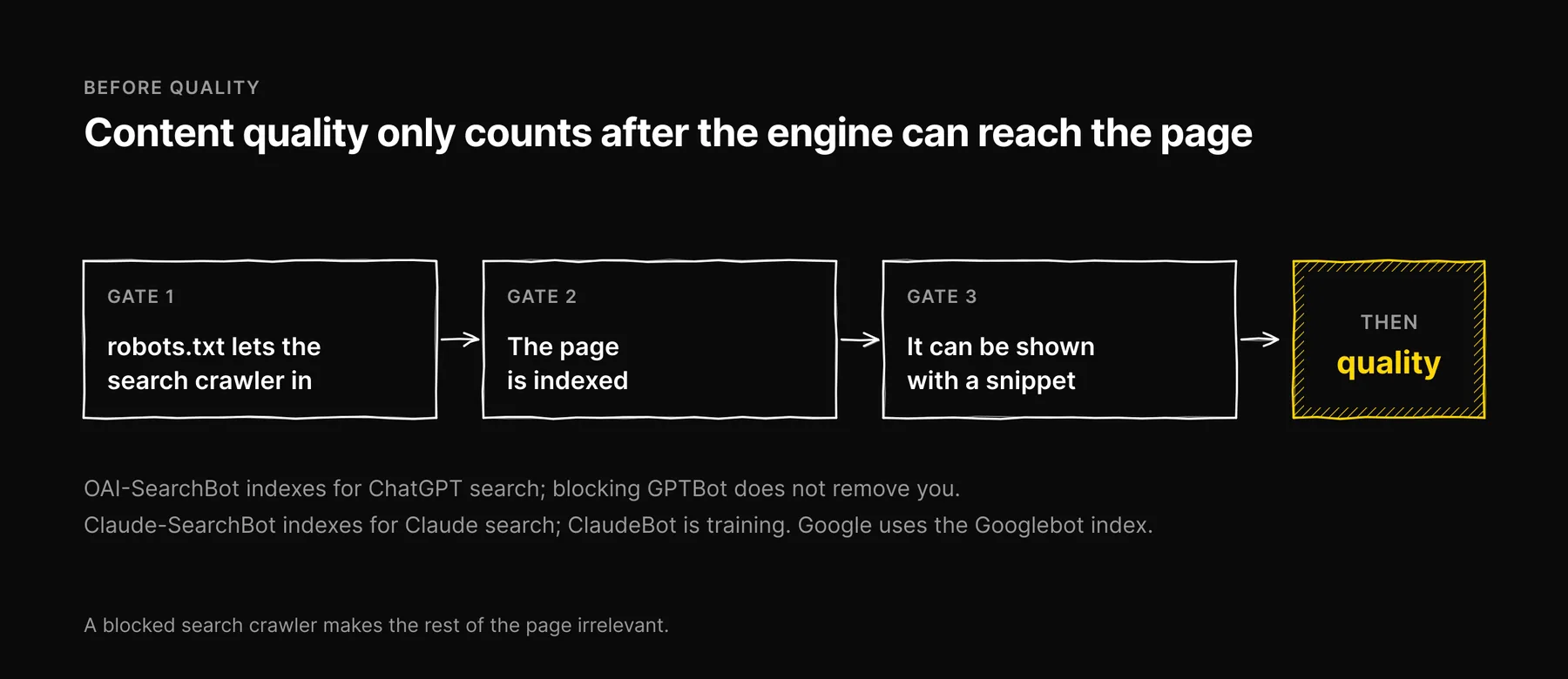
Content quality does not matter if the crawler an engine uses for its search index is blocked. The names are specific. OpenAI's OAI-SearchBot indexes pages for ChatGPT search, while GPTBot collects content that may be used for training; blocking GPTBot does not remove you from ChatGPT search, blocking OAI-SearchBot does. Anthropic runs Claude-SearchBot to index pages for search, separate from ClaudeBot, which collects content that may contribute to training, and Perplexity runs PerplexityBot. Google's AI features use the normal Googlebot index.
Our guide to the five AI engines we track covers each one's crawlers and sources in detail. For this post, the check is simple: confirm your robots.txt lets the search crawlers in, and that your key pages are indexed.
The signals, with the evidence behind each
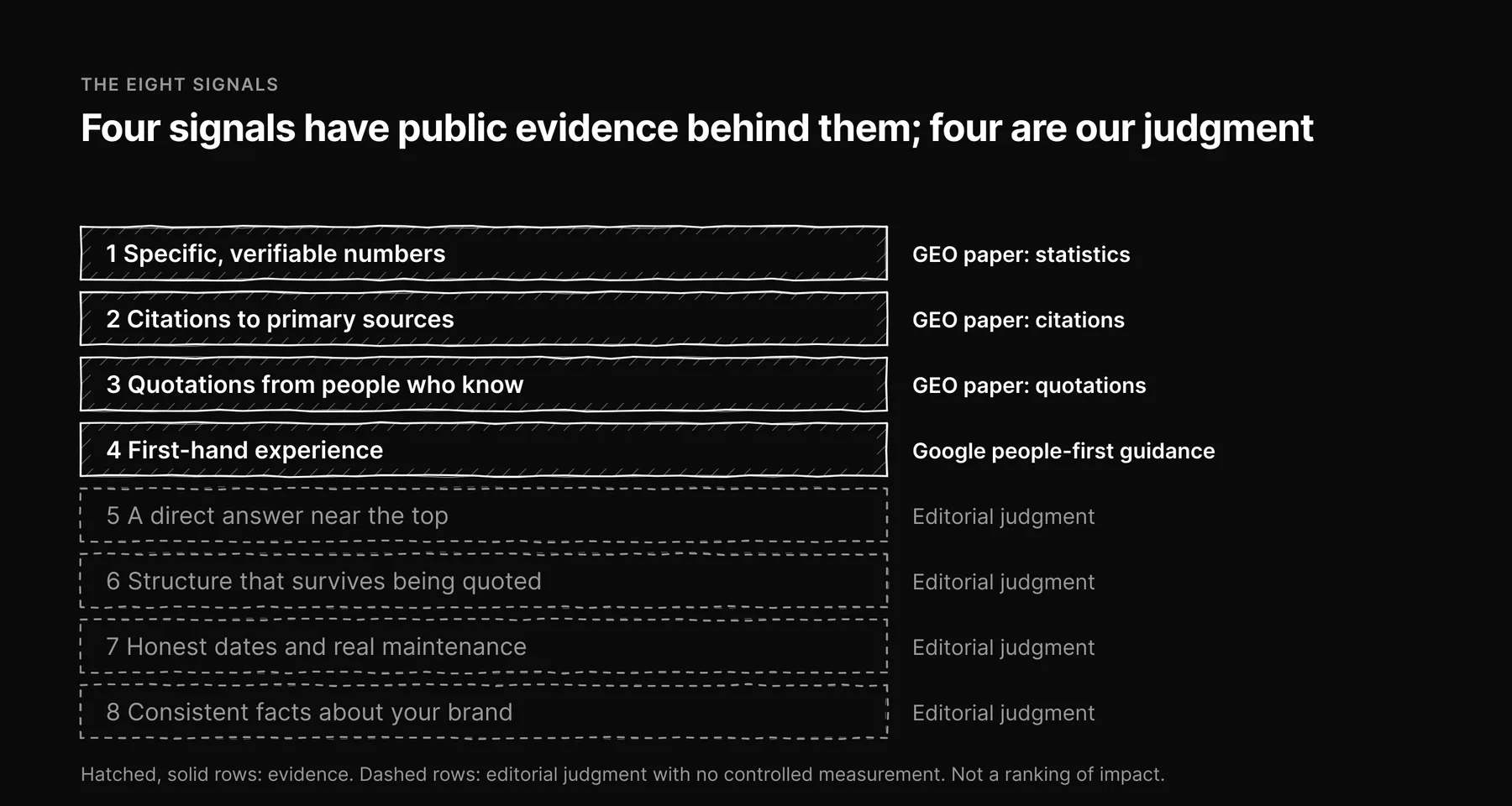
1. Specific, verifiable numbers
Evidence: GEO paper (statistics). A number with a date and a source gives an engine something it can state and attribute. "Most shoppers compare prices" gives it nothing. When you use a figure, say where it came from and when it was measured. If it is your own rule of thumb, say that too.
2. Citations to primary sources
Evidence: GEO paper (citations). Link to the study, the documentation or the dataset itself, not to someone else's summary of it. This also protects you: if the source changes, you can see it.
3. Quotations from people who know
Evidence: GEO paper (quotations). Adding relevant, attributed quotations raised a source's visibility in the benchmark. Use real quotes from real people you can name. Never invent them, and never attribute a paraphrase as a quote.
4. First-hand experience
Evidence: Google's people-first guidance. Say what you did, what you measured and what you saw. Original data and first-hand notes are the part of a page no one else can supply, which is why they are worth citing.
5. A direct answer near the top
Editorial judgment. We put a short, plain answer to the page's main question in the first paragraphs. It helps readers first. We believe it also makes the page easier to quote, but we have no controlled measurement of that.
6. Structure that survives being quoted
Editorial judgment. Headings that say what the section answers, one idea per paragraph, tables for comparisons and lists for steps. A paragraph that only makes sense after the three before it is hard to lift into an answer.
7. Honest dates and real maintenance
Editorial judgment. Show when the page was last updated, and change that date only when the substance changes. Freshening the year in a title without touching the content misleads readers.
8. Consistent facts about your brand
Editorial judgment. Use the same name, the same description and the same key facts on your site, your profiles and your structured data. Conflicting facts give an engine a choice, and it may pick the wrong one.
What does not help
Evidence: GEO paper (keyword stuffing). Repeating a target phrase did not raise visibility in the experiments. Neither, in our judgment, does padding a page to a word count. Length is only useful when each section adds information.
Our editorial priorities
This table is our judgment about where to spend effort. It is not a measurement of impact, and the order is ours.
| Signal | Evidence behind it | Our effort estimate |
|---|---|---|
| Crawlable, indexed, snippet-eligible | Google documentation | Low, and it comes first |
| Specific numbers with sources | GEO paper | Medium |
| Citations to primary sources | GEO paper | Low |
| Attributed quotations | GEO paper | Medium to high |
| First-hand experience and original data | Google guidance | High |
| Direct answer, quotable structure | Editorial judgment | Low |
| Honest dates, consistent brand facts | Editorial judgment | Low, ongoing |
Can AI engines detect AI-written content?
We know of no public evidence that AI answer engines identify text as AI-written and cite it less for that reason. The practical problem with generic AI-written pages is simpler: they rarely contain a specific fact, a source or an experience worth quoting. A page with nothing citable does not get cited, whoever or whatever wrote it. That matches the people-first standard in Google's guidance, which asks whether content helps the reader rather than how it was produced.
How we write and check Ezeo's own content
We run a measurement platform, so the rules we apply to our data also apply to our writing.
- Every figure traces to a source. A study, a vendor's own documentation, or a measurement we can re-run. If a number is our own threshold, the text says so.
- Not measured is not zero. In the Ezeo product, if an engine was not checked, the screen shows a dash, never a 0. A zero is a measurement; a missing check is not. We apply the same rule in posts: if we do not know, we say so instead of filling the gap.
- A refusal is not an empty result. We once lost months of brand-mention data because a provider rejected a request and the code read the empty response as "no mentions found". Every scan reported success. Since then, our writers and our code both separate "we found nothing" from "we could not look".
- Claims about engines get checked against the engine's own documentation. Crawler names and behaviours come from the providers' pages, which we link, because second-hand summaries go stale.
How to tell whether your changes worked
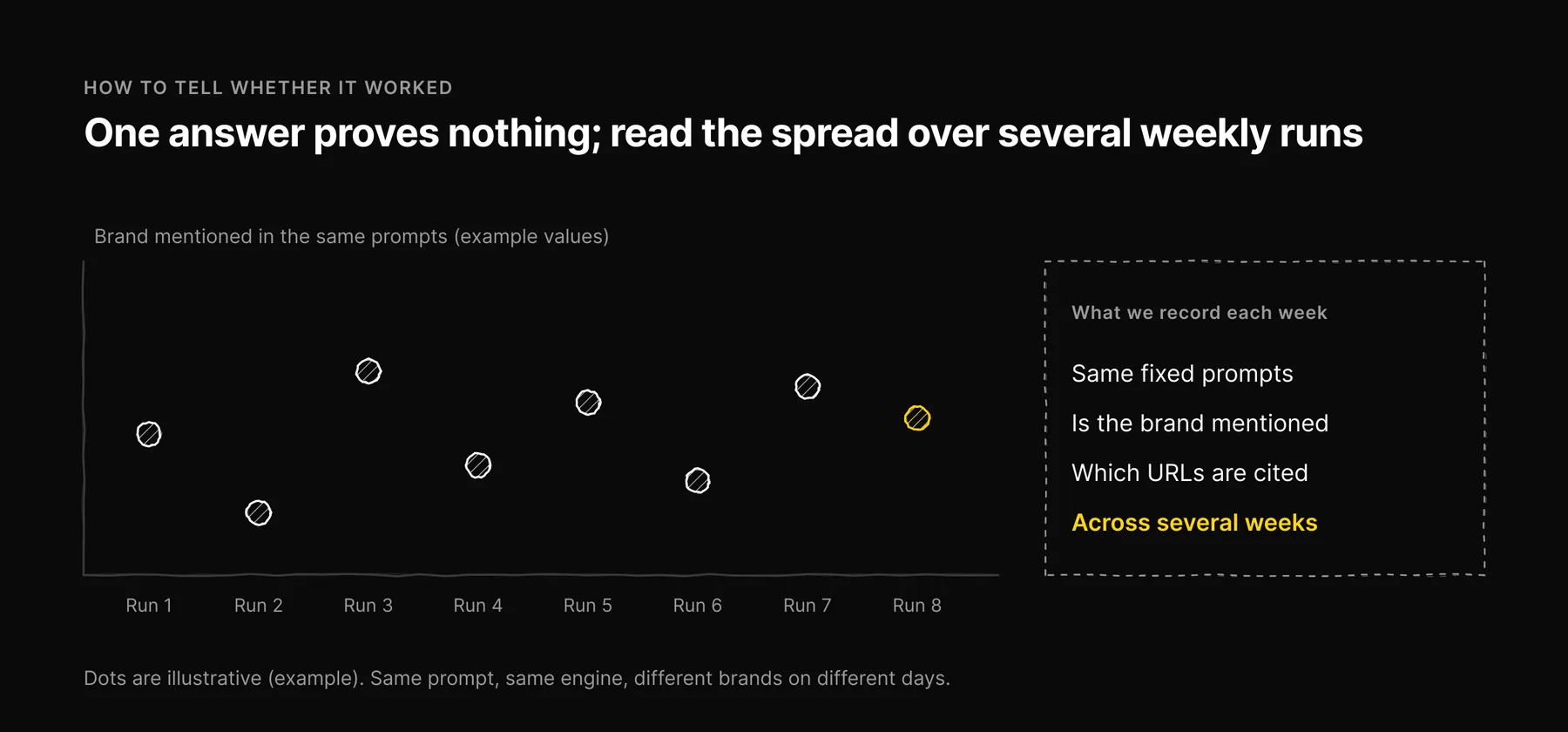
AI answers vary. The same prompt to the same engine can name different brands on different days, and results differ by location and by whether the user is logged in. One screenshot proves nothing.
In Ezeo we ask each of the five engines the same fixed set of prompts about a brand's category every week, and record whether the brand is mentioned and which URLs are cited. Google AI Overviews are read from the live results page, not simulated. After a content change, we look at the spread over several weekly runs rather than at a single answer. Our AI visibility audit guide walks through doing this by hand.
Self-audit checklist
Run this against your most important pages.
- Is the page indexed, and allowed to show a snippet?
- Does robots.txt let each engine's search crawler reach it?
- Does the first paragraph answer the page's main question in plain words?
- Does every number have a source and a date, or a label saying it is your own estimate?
- Do links point to primary sources rather than summaries?
- Are quotations real, named and attributed?
- Is there at least one thing on the page only you could have written: your data, your process, your result?
- Can each section be understood on its own if it is quoted alone?
- Is the "last updated" date honest?
- Are your brand name and key facts identical to what your other pages and profiles say?
- Have you removed filler, repeated phrasing and keyword repetition?
For the full list of technical and off-site work that sits around content, see our complete AI visibility checklist.
What changed in the September 2026 update: We removed the claim that AI models can detect AI-generated boilerplate and the table ranking signals by "impact on citation", neither of which had evidence behind it, and corrected the count of AI engines we track to five, not six.
Frequently asked questions

Written by
Jose Antonio Mijares
SEO & GEO Expert | Founder at Ezeo