
Updated September 2026. This post answers which AI search engines a brand should optimize for in 2026, where each one gets its answers, and which crawler you need to let in for each.
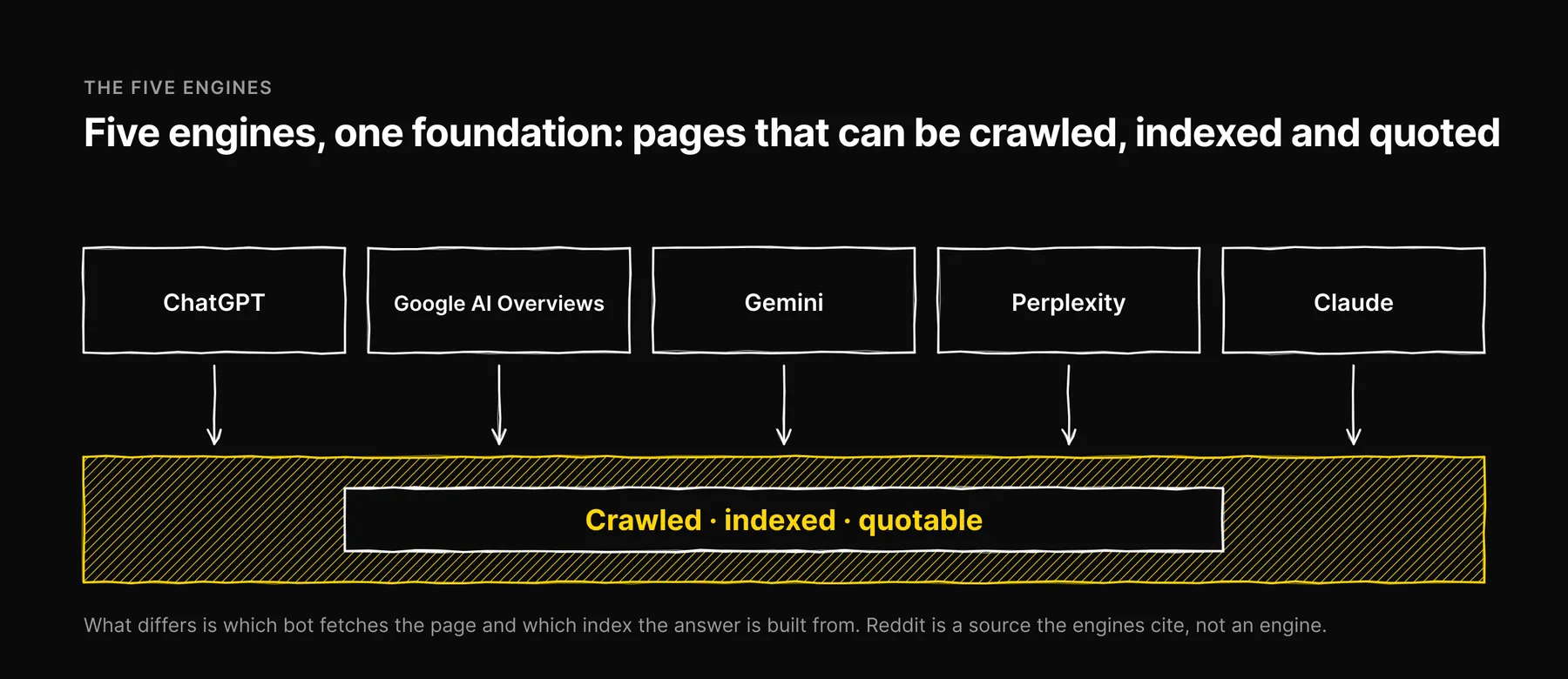
Optimize for five: ChatGPT, Google AI Overviews (with AI Mode), Gemini, Perplexity and Claude. These are the five surfaces Ezeo measures every week. They share one foundation, which is pages that can be crawled, indexed and quoted, so most of the work is done once. The differences are which bot fetches your pages and which index the answer is built from, and that is what this guide covers engine by engine.
Reddit is not on the list. It is a source the engines read and cite, not an answer engine Ezeo scores, and it has its own section below. Grok is not tracked either; we list an engine only once we can collect its answers.
The five engines at a glance
This table is our summary of each vendor's published documentation, linked in the sections below. The last column is our recommendation, not a vendor rule.
| Engine | Where answers come from | Crawler to allow | First thing we check |
|---|---|---|---|
| Google AI Overviews and AI Mode | Google's normal Search index | Googlebot | The page is indexed and allowed a snippet |
| ChatGPT | Training data, OpenAI's own search index, third-party search providers, live page fetches | OAI-SearchBot, ChatGPT-User | robots.txt does not block OAI-SearchBot |
| Gemini | Model knowledge, can ground answers in Google Search results | Googlebot; Google-Extended is a separate choice | Same indexing work as Google Search |
| Perplexity | Its own index plus live fetches | PerplexityBot, Perplexity-User | Both agents are allowed on public pages |
| Claude | Training data plus web search | Claude-SearchBot, Claude-User | Both agents are allowed on public pages |
Notice that none of the five requires a special file, markup or submission to be eligible. Each one needs to be able to reach and read the page.
Google AI Overviews and AI Mode
Where the answers come from
AI Overviews and AI Mode are features of Google Search. Google's own guidance on AI features and your website says there are no extra technical requirements beyond normal Search: a page has to be indexed and eligible to be shown with a snippet. Both features are built from the index that Googlebot crawls.
What to allow
Allow Googlebot. That is all. The nosnippet and max-snippet controls limit how much of a page can be shown, so a page that sets them tightly can be indexed and still give the AI features little to quote.
The Google-Extended confusion
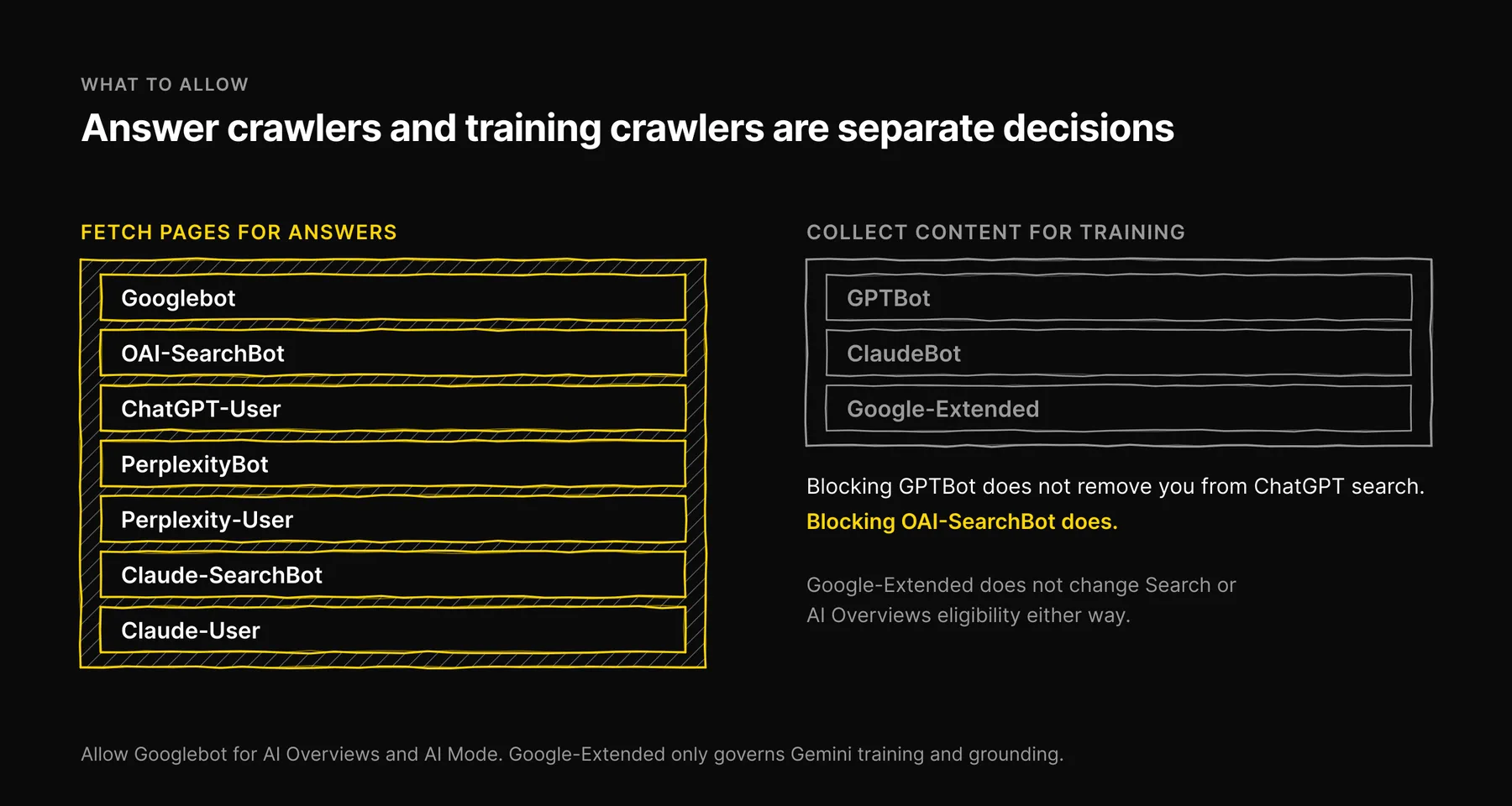
Google's crawler documentation describes Google-Extended as a robots.txt token that controls whether your content is used for Gemini model training and grounding. It has no effect on inclusion in Google Search or in AI Overviews. Blocking it does not remove you from AI Overviews, and allowing it does not add you.
What to do
- Confirm your key pages are indexed in Search Console, not just published.
- Check that no template adds
nosnippetor a very smallmax-snippetto pages you want quoted. - Write the answer to the query near the top of the page in plain sentences. AI Overviews quote passages, so a clear passage is easier to use than a paragraph that builds up to the point.
In Ezeo we read AI Overviews from the live Google results page, fetched through DataForSEO's SERP API with the AI Overview loaded. We do not simulate them. AI Mode is a separate surface in the same product; we mention it here because the same indexing work covers it.
ChatGPT
Where the answers come from
ChatGPT has more than one path to your content. The model has training data. ChatGPT search, launched in October 2024, draws on OpenAI's own index built by OAI-SearchBot and on third-party search providers, and Bing has been one of them. When a user's request needs a specific page, ChatGPT-User fetches it. OpenAI documents all three agents on its bots page.
What to allow
Allow OAI-SearchBot and ChatGPT-User on public pages. GPTBot collects content that may be used for training, and it is a separate decision. The practical point: blocking GPTBot does not remove you from ChatGPT search results. Blocking OAI-SearchBot does.
How much Bing matters
Bing has been one of the providers ChatGPT search uses, so setting up Bing Webmaster Tools and IndexNow is still worth an afternoon. But ChatGPT also has its own index, and we cannot see how it weights each source. Treat Bing as one input you can influence, not the switch.
ChatGPT is the engine most people ask us about, so it has its own guide: how to get ChatGPT to recommend your brand.
Gemini
Where the answers come from
Gemini answers from what the model learned and can ground its answers in Google Search results. When it grounds, the same indexing that feeds Google Search is what makes your page available.
What to allow
Allow Googlebot, which you already do if you want to be in Google Search. Then decide on Google-Extended deliberately. Per Google's documentation it controls use of your content for Gemini training and grounding, so blocking it is a trade-off: it keeps your content out of those uses, and it may also keep it out of Gemini answers that would otherwise draw on it. It does not change your Google Search or AI Overviews eligibility either way.
What to do
Most of the Gemini work is the Google work above. Keep your brand facts consistent between your site and your Google Business Profile if you have one, because a model grounding a branded answer will find both.
Perplexity
Where the answers come from
Perplexity runs its own index and shows its sources alongside its answers, which makes it the easiest engine to audit: you can see which URLs it used. Its bot documentation lists PerplexityBot, which indexes pages for Perplexity's results, and Perplexity-User, which fetches pages when a user's question needs them.
What to allow
Allow both on public pages. If you block PerplexityBot, you are asking to be left out of the index its answers are drawn from.
What to do
Publish pages that carry their own evidence: named sources, dates, and figures with a stated origin. The GEO research paper (Aggarwal et al., 2023, published at KDD 2024) found that adding citations, quotations from relevant sources and statistics raised a source's visibility in generative engine answers on their benchmark, by up to about 40%, while keyword stuffing did not help. Treat that as a benchmark result, not a law. More on this in the content signals AI models actually cite.
Claude
Where the answers come from
Claude has had web search since 2025. It answers from what the model learned and, when it searches, from pages it finds and fetches.
What to allow
Anthropic's help centre lists three agents. ClaudeBot collects content that may contribute to training. Claude-SearchBot indexes content to improve search quality. Claude-User fetches a page when a user asks Claude something that needs it. All three honour robots.txt, and Anthropic supports Crawl-delay. As with OpenAI, the training bot and the search bots are separate decisions: you can block ClaudeBot and still allow the two that affect answers.
What to do
Nothing Claude-specific beyond access. Clear pages with sourced claims do well here for the same reasons they do in Perplexity.
One robots.txt, written carefully
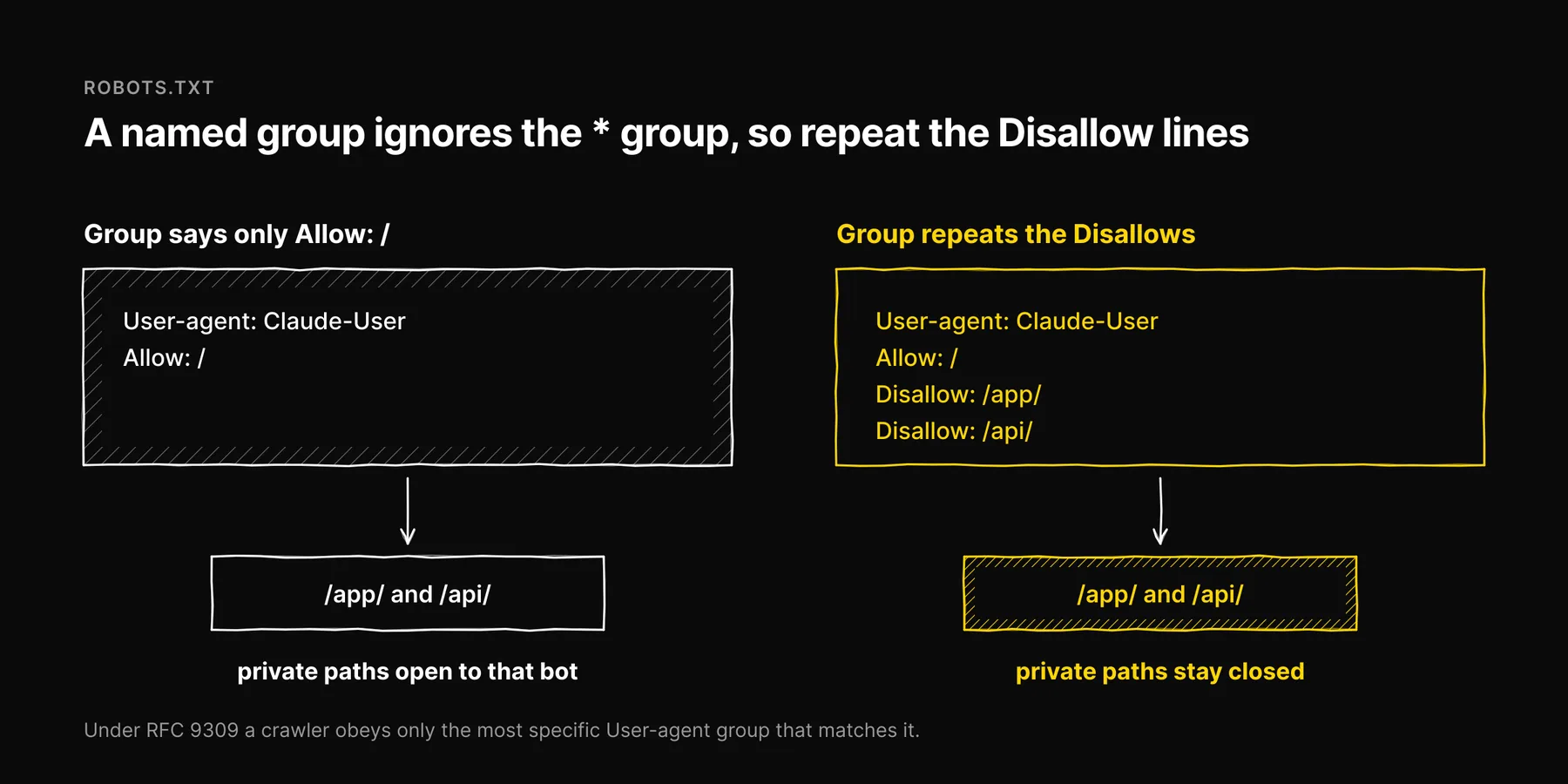
The example below is an illustration of the pattern, not an excerpt of our own file: AI search crawlers are allowed on public pages and kept out of the app and the API.
User-agent: *
Disallow: /app/
Disallow: /api/

User-agent: OAI-SearchBot
User-agent: ChatGPT-User
User-agent: PerplexityBot
User-agent: Perplexity-User
User-agent: Claude-SearchBot
User-agent: Claude-User
Allow: /
Disallow: /app/
Disallow: /api/
The detail that matters is repeating the Disallow lines in every named group. Under the robots.txt standard (RFC 9309), a crawler obeys only the most specific User-agent group that matches it and ignores the * group when it has its own. A named group that only says Allow: / opens your private paths to exactly that bot. Our own robots.txt on ezeo.ai repeats the /app/ and /api/ disallows in every named group for this reason. Whether you add GPTBot, ClaudeBot or Google-Extended is a separate training decision, and the same rule applies to any group you add.
Where Reddit fits
Reddit is not one of the engines, and Ezeo does not score it. It matters because the engines read it. Community threads can appear among the sources engines cite, especially for product and recommendation questions, which means a thread about your category can shape an answer about your category.
What that means in practice:
- Find out whether Reddit is a source for your category before investing in it. Run your category prompts and look at the cited URLs. If Reddit threads never appear, your effort is better spent elsewhere.
- If they do appear, read them. Correct factual errors about your product in the open, under your real name, and answer questions where you have real expertise.
- Do not seed threads or post under fake accounts. Communities spot it, moderators remove it, and a thread calling it out is exactly the kind of source you do not want an engine to cite.
Where to start
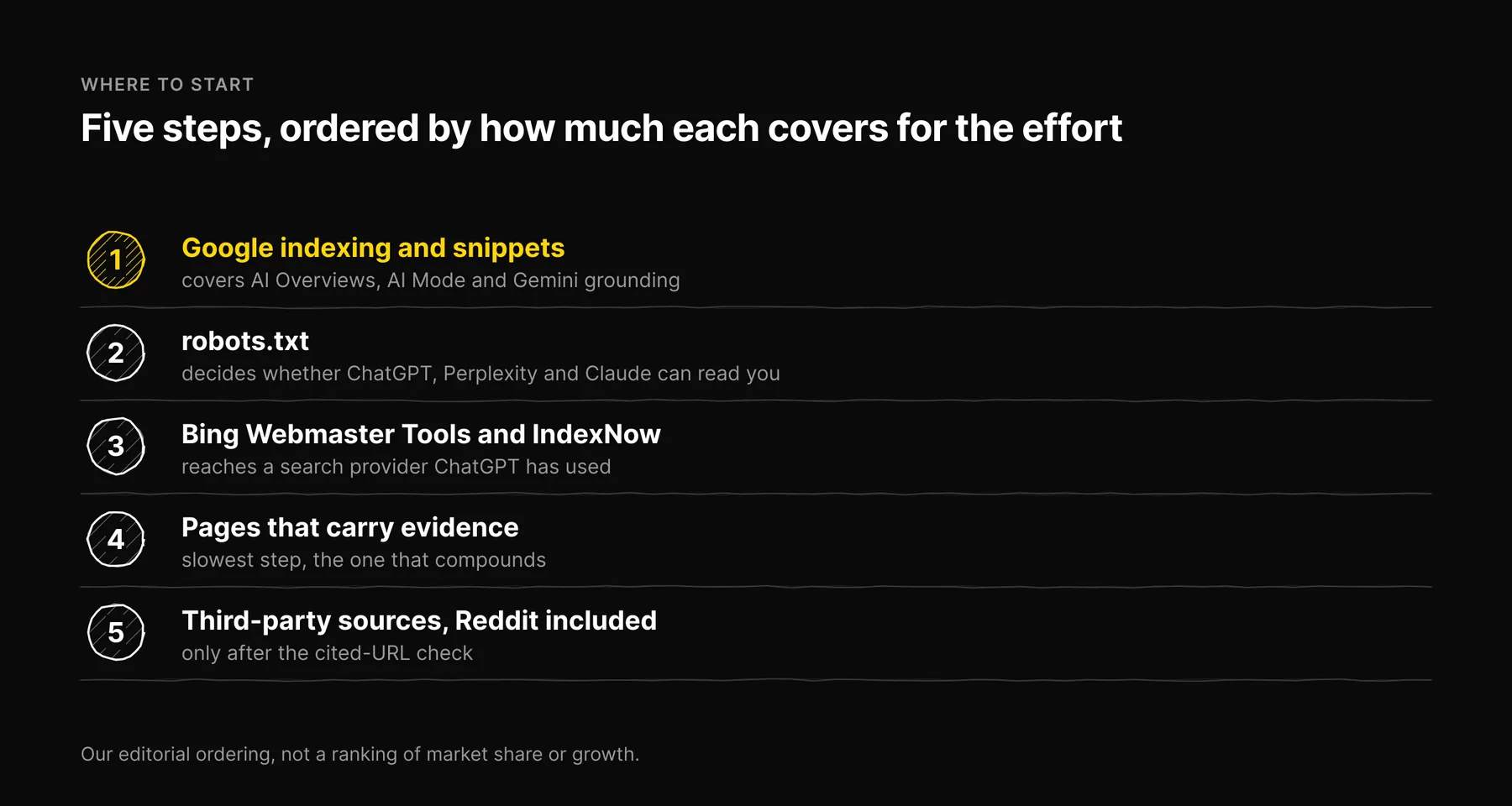
This is our editorial ordering, not a ranking of market share or growth. We ordered it by how much each step covers for the effort.
- Google indexing and snippets. One piece of work covers AI Overviews, AI Mode and Gemini's grounding, and you need it for search traffic anyway.
- robots.txt. A single file decides whether ChatGPT, Perplexity and Claude can read you. It takes minutes to check and a mistake here silently removes you.
- Bing Webmaster Tools and IndexNow. Cheap to set up, and it reaches a search provider ChatGPT has used.
- Pages that carry evidence. Sourced claims and direct answers help on every engine. This is the slowest step and the one that compounds.
- Third-party sources, Reddit included. Only after the cited-URL check tells you which ones your category relies on.
The full checklist for each step is in our complete AI visibility optimization guide.
How we track the five
In Ezeo we ask each engine the same fixed set of prompts about a brand's category every week. For each answer we record whether the brand is mentioned and which URLs are cited. Answers vary from run to run, so a single week is a reading, not a verdict; the trend over several weeks is what we act on.
We hold ourselves to one measurement rule: not measured is not zero. If an engine was not checked, we show a dash, never a 0. A rejected request and "no mentions found" are recorded as different results in Ezeo, and they should be in your own tracking too.
If you want to do this by hand first, our step-by-step AI visibility audit shows the spreadsheet and the prompt set.
What changed in the September 2026 update: Ezeo tracks five AI engines, not six: Reddit is a source the engines cite, not an engine we score. Claude has had web search since 2025, and Bing is one input to ChatGPT search, not the switch that controls it.
Frequently asked questions
Written by
Jose Antonio Mijares
SEO & GEO Expert | Founder at Ezeo