
Updated September 2026. This post explains what Generative Engine Optimization (GEO) is, where the term comes from, what it measures and what it does not do.
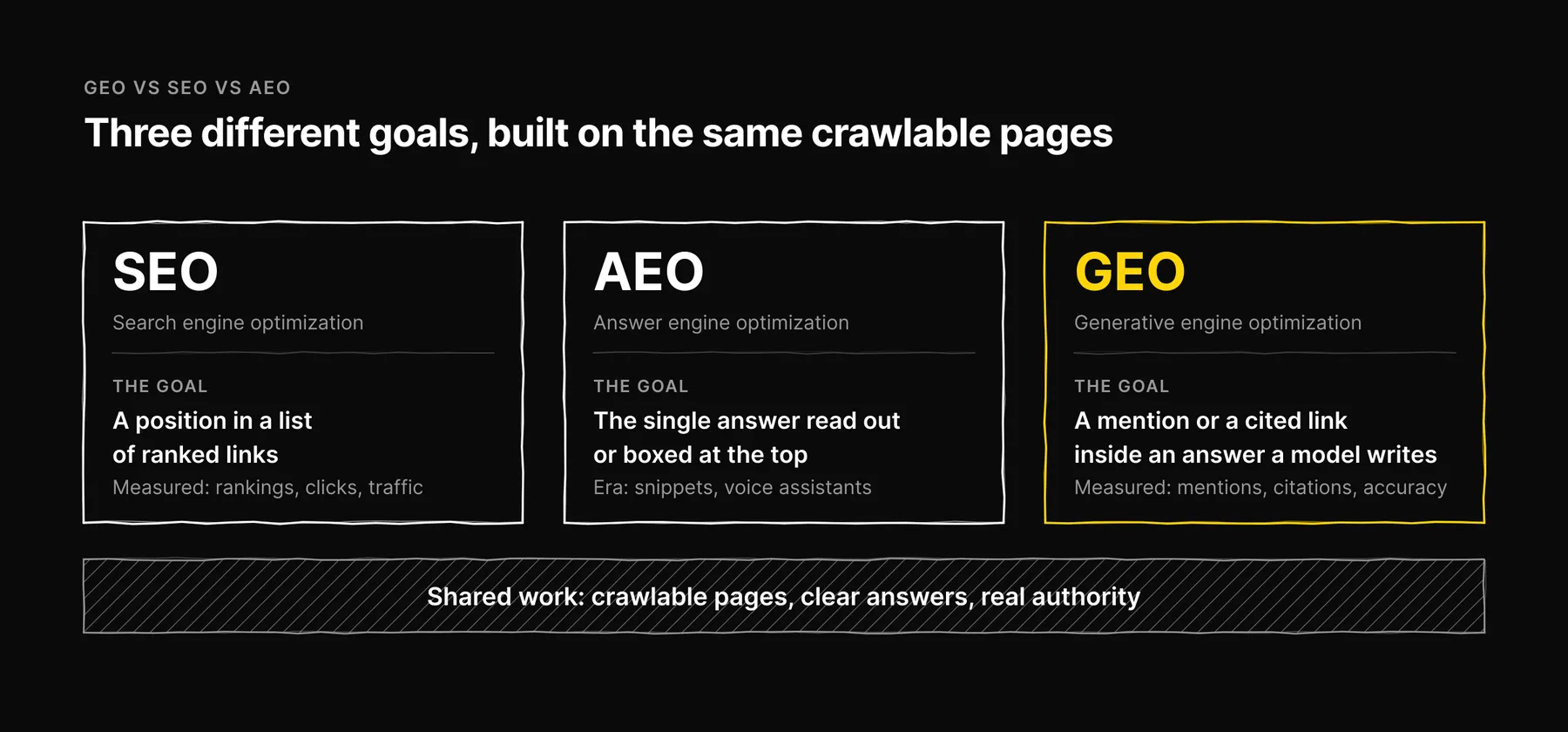
GEO is the work of making a brand show up, accurately, in answers written by AI systems such as ChatGPT, Claude, Gemini, Perplexity and Google's AI Overviews. SEO earns you a position in a list of links. GEO earns you a mention or a cited link inside a generated answer. The two overlap heavily, because most of these engines build their answers from pages they found through search.
We run a measurement platform for this, so this post sticks to what we can check: where the idea started, how it differs from SEO and AEO, what is worth measuring, and the misconceptions we see most often.
Where the term GEO comes from
"Generative Engine Optimization" was named in a research paper, GEO: Generative Engine Optimization, by Pranjal Aggarwal and co-authors from Princeton and other institutions. It first appeared on arXiv in November 2023 and was published at KDD 2024.
The paper did something useful: it treated the question as an experiment. The authors built a benchmark of queries, ran them through a generative engine that retrieves sources and writes an answer, and then changed the source pages in controlled ways to see which edits made a source more visible in the final answer.
What the paper found
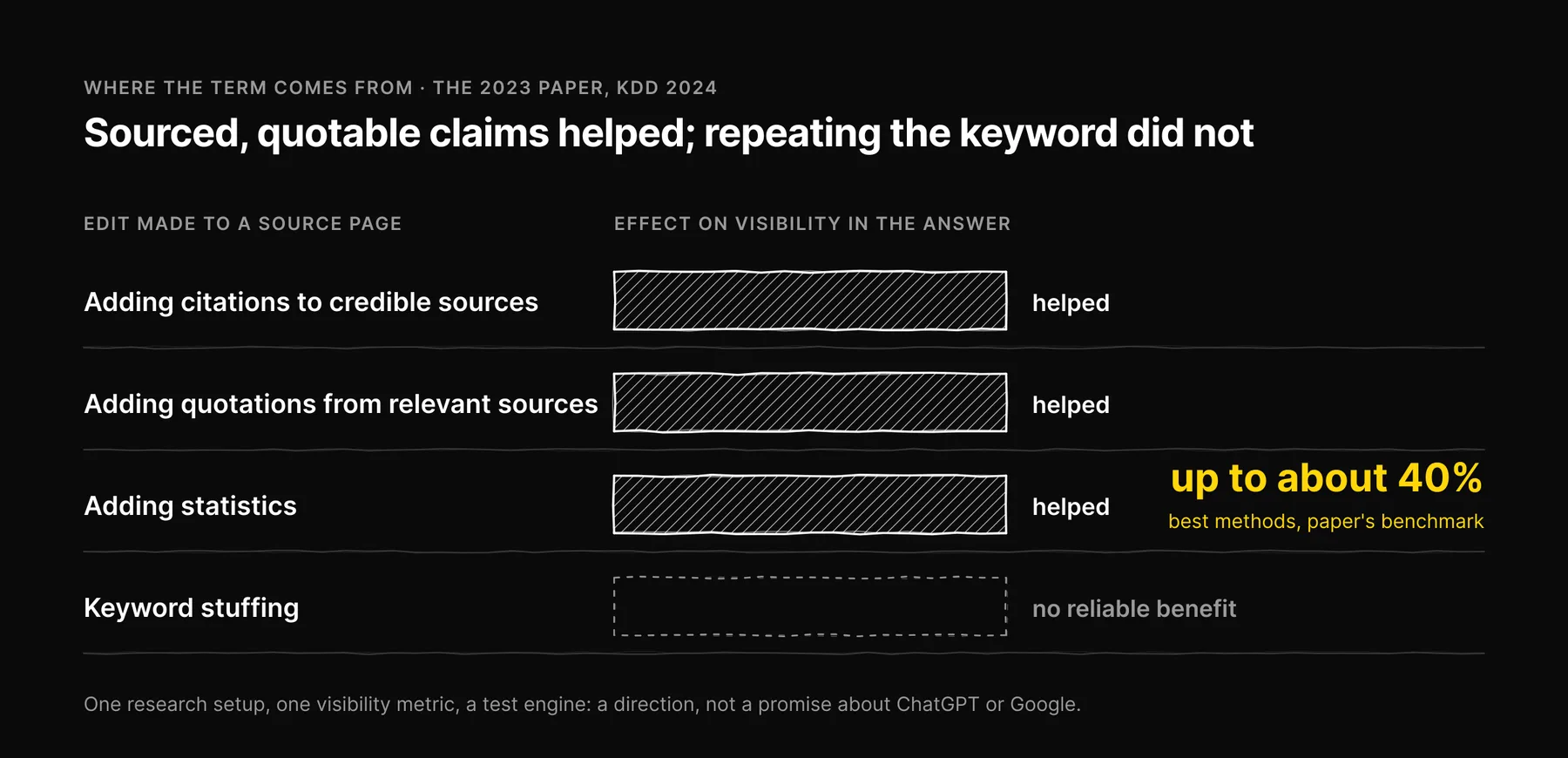
- Adding citations to credible sources raised a page's visibility in the generated answers.
- Adding quotations from relevant sources helped.
- Adding statistics helped.
- Keyword stuffing did not help. The old SEO trick of repeating the target phrase had no reliable benefit in their setup.
The best methods improved visibility by up to about 40% on the paper's own benchmark. Read that number for what it is: a result from one research setup, with one visibility metric, on a test engine. It is not a promise about ChatGPT or Google, and nobody should quote it as one. What carries over is the direction. Pages that make specific, sourced, quotable claims are easier for a generative engine to use than pages that repeat a keyword.
Definition: Generative Engine Optimization (GEO) is the practice of improving how often, and how accurately, a brand is mentioned and cited in answers generated by AI systems.
GEO vs SEO vs AEO
SEO (search engine optimization) aims at ranked results: you want your page high in a list, and you measure rankings, clicks and traffic. AEO (answer engine optimization) is an older term from the era of featured snippets and voice assistants, where the goal was to be the single answer read out or boxed at the top. GEO covers answers that a language model writes itself, often drawing on several sources at once, where your brand might be named without a link, linked without being named, or described wrongly. In practice the three share most of the same work: crawlable pages, clear answers, real authority. For how the SEO side holds up, see our piece on why SEO still matters alongside GEO.
How a generative answer gets built
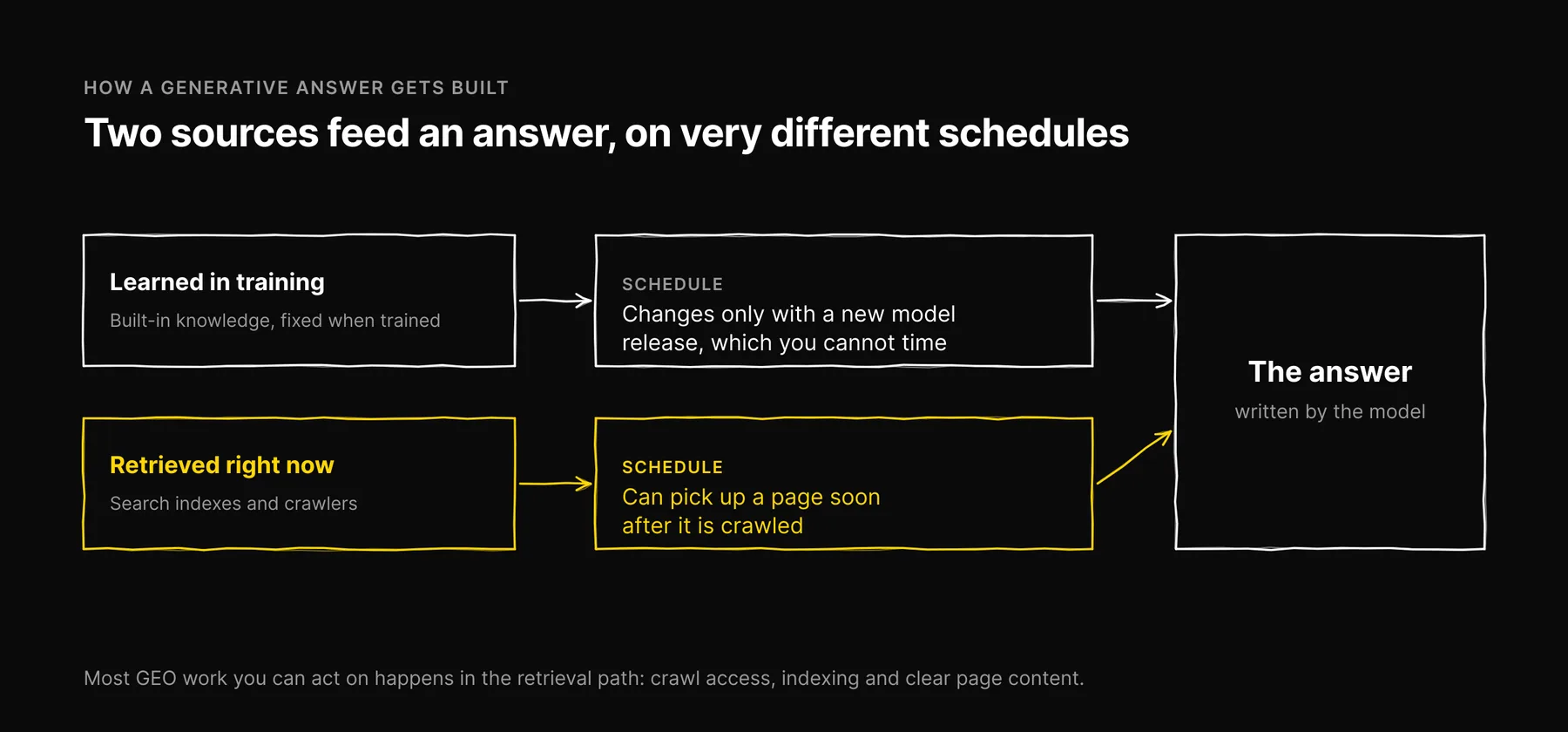
It helps to know the two places an AI answer can come from, because they respond to your work on very different schedules.
- What the model learned in training. A model's built-in knowledge is fixed when it is trained. If your brand was barely present on the web before that point, the model may not know you. Changing this takes a new model release, and you can't control when that happens.
- What the engine retrieves right now. ChatGPT search, Claude with web search, Perplexity, Gemini and Google's AI Overviews can all look things up at answer time. Retrieval runs on search indexes and crawlers, and it can pick up a page soon after it is crawled.
Most of the GEO work you can act on happens in the second path. That is why crawl access, indexing and clear page content matter so much. It is also why Claude is not limited to its training data: it has had web search since 2025, and Anthropic runs a search crawler for it.
Which engines this applies to
We track five AI surfaces in Ezeo: ChatGPT, Claude, Gemini, Perplexity and Google AI Overviews. Each finds and cites sources a little differently. OpenAI, Anthropic and Perplexity run their own crawlers, while Gemini and AI Overviews lean on Google Search. The details, and what to do on each, are in our guide to the five AI engines we track. Reddit comes up often in this discussion. We treat it as a source the engines read and cite, not as an engine we score.
What GEO actually measures
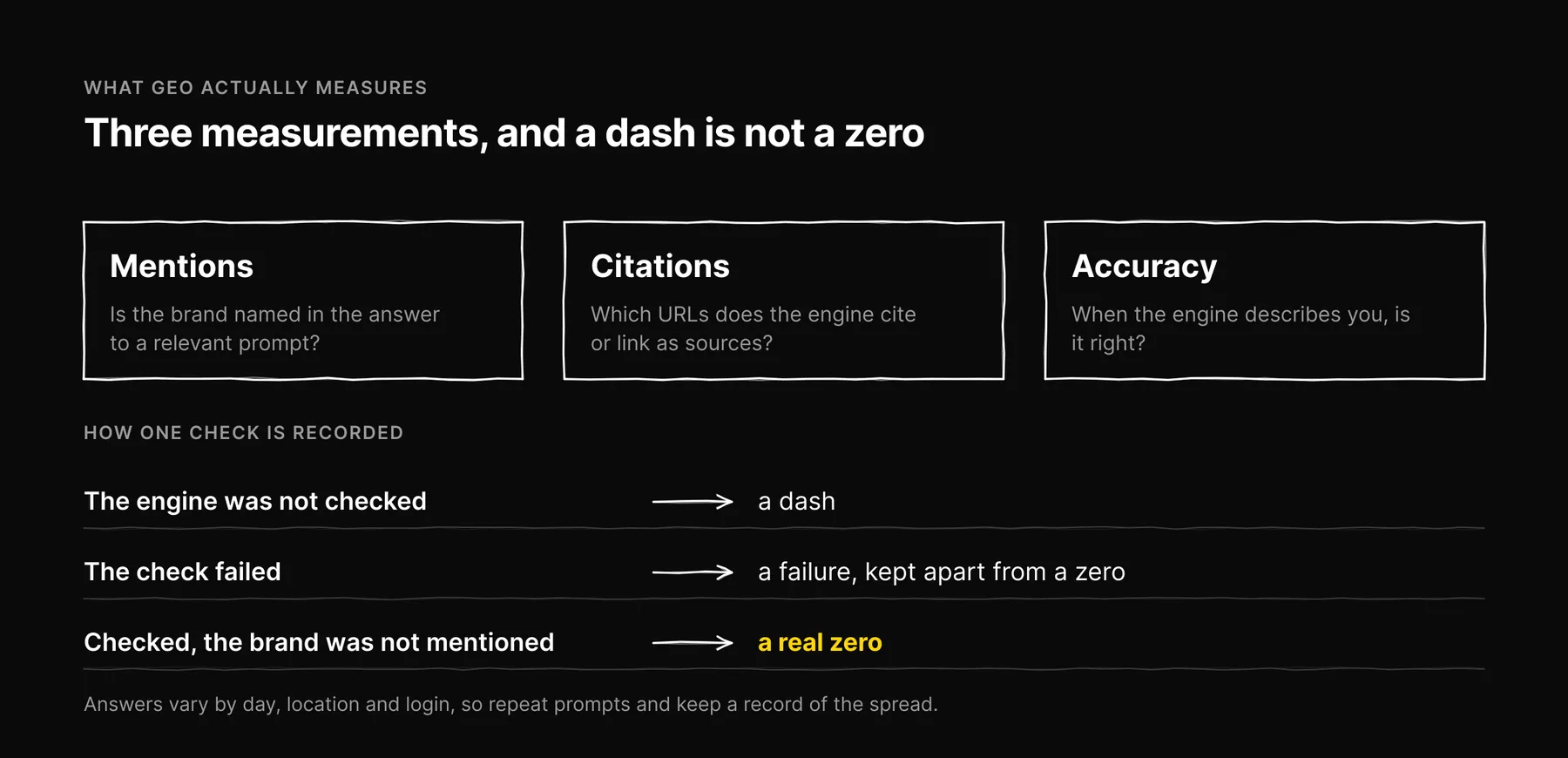
Rankings don't transfer cleanly to generated answers, because there is no fixed page one. Three measurements do most of the work.
Mentions
Is the brand named in the answer to a relevant prompt? This is the basic visibility signal. It covers answers where no link appears at all, which is common when a user asks for recommendations.
Citations
Which URLs does the engine cite or link as sources? A citation to your own page is the closest thing GEO has to a click opportunity. A citation to a review site, a forum thread or a competitor's comparison page tells you where the engine is getting its view of your category.
Accuracy
When the engine describes you, is it right? Wrong prices, discontinued products and confused brand names are real problems, and a mention count won't reveal them. Someone has to read the answers.
Around these three, most teams also track share of voice: how often you are named compared with the competitors named in the same answers.
How we measure it in Ezeo
Every week, Ezeo asks each engine the same fixed set of prompts about a brand's category. For each answer we record whether the brand is mentioned and which URLs are cited. For Google AI Overviews we read the real Google results page, with the AI Overview loaded, through DataForSEO's SERP API. We don't simulate it.
Two rules keep those numbers honest:
- Answers vary. The same prompt to the same engine can name different brands on different days, and results change with location and whether the user is logged in. One screenshot is an anecdote. You need repeated prompts and a record of the spread.
- "Not measured" is not "zero". If an engine wasn't checked, we show a dash, not a 0. A failed check is not a zero: a request that failed and a brand with no mentions are different facts, and your tracking has to keep them apart.
Common misconceptions about GEO
"AI engines are replacing Google"
Google's AI Overviews and AI Mode are features of Google Search. Google's own guidance on AI features and your website says they are built from the normal Search index, with no extra technical requirements: a page has to be indexed and eligible to show with a snippet. More answers are being written by AI, and some of them appear on Google itself. That changes how people get answers. It doesn't mean search is going away.
"GEO replaces SEO"
For most retrieval-based answers, a page has to be crawled and indexed before any engine can cite it. That makes SEO the entry ticket. GEO adds work on top: answer-shaped content, consistent brand facts, third-party mentions and a way to measure mentions and citations.
"You can game it with keywords"
The one controlled study we have says no. In the GEO paper, keyword stuffing didn't reliably raise visibility, while sourced claims, quotations and statistics did. Hidden text, fake reviews and prompt-injection tricks are worse: they are the kind of manipulation search and AI providers work to filter out, and they put the whole domain at risk.
"One file or one tag fixes it"
Adding an llms.txt file, schema markup or a crawler rule can remove a blocker. None of them makes an engine recommend you. What gets cited is covered in our breakdown of the content signals AI answers actually draw on.
"This only matters for tech companies"
Any business whose customers ask an assistant "what's the best X for Y" before buying is affected. That includes local services, e-commerce and professional services. The prompts look different; the mechanics are the same.
How to get started
Our recommendation, in order:
- Get a baseline. Write 20-30 prompts a real customer would ask, run them on each engine more than once, and record mentions, cited URLs and errors. That prompt count is our working starting point, not an industry standard. Our step-by-step AI visibility audit covers the method.
- Remove blockers. Check that the search crawlers of each engine can reach your public pages, and that your key pages are indexed and allowed to show snippets.
- Fix what the answers get wrong. Start with inaccurate descriptions of your brand. They cost you more than missing mentions, and they usually trace back to a specific out-of-date page, profile or listing.
- Work through the full checklist. Our step-by-step AI visibility optimization checklist covers foundation, content, technical and measurement work in order.
Then keep measuring on a fixed schedule with the same prompts. GEO results move slowly and noisily, so a fixed prompt set checked week after week is the only way we know to tell a real change from a lucky week.
What changed in the September 2026 update: AI engines are not replacing Google: AI Overviews and AI Mode are Search features. Ezeo tracks five AI engines, not six (Reddit is a source, not an engine we score), Claude has had web search since 2025, and Bing is not a direct lever for ChatGPT visibility.
Frequently asked questions

Written by
Jose Antonio Mijares
SEO & GEO Expert | Founder at Ezeo