
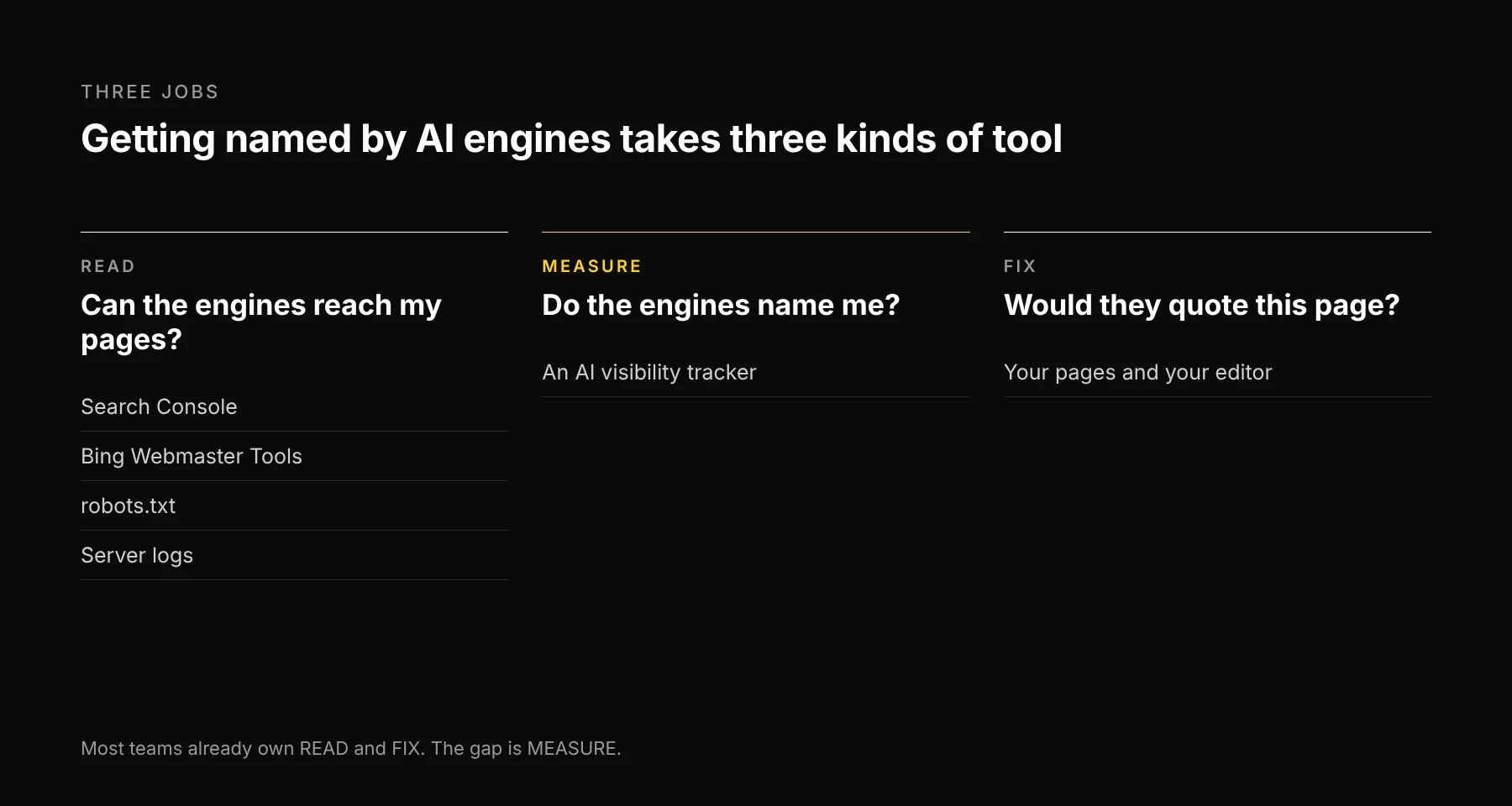
Short answer: no single tool puts your brand into AI answers. You need three kinds of tool, for three jobs: one that checks the engines can read your site, one that measures whether they name you, and one that helps you fix the pages they would quote. Most teams already own the first and the third. The one they're missing is the measurement.
This post groups the tools by job, says what each kind can and can't tell you, and ends with four things to check before you pay for an AI visibility tracker, ours included.
Job 1: make sure the engines can read you
If ChatGPT's crawler is blocked, no tracker and no content tool will fix it. Check access first. It's free and it takes ten minutes.
| Tool | What it answers |
|---|---|
| Google Search Console | Are my pages indexed and allowed a snippet? This covers AI Overviews, AI Mode and Gemini's grounding. |
| Bing Webmaster Tools + IndexNow | Is Bing seeing my new pages? Bing has been one of the search providers behind ChatGPT search. |
| Your robots.txt | Can OAI-SearchBot, PerplexityBot and Claude-SearchBot reach my public pages? |
| Your server logs or CDN | Did those bots actually come, and what did they get back? |
The robots.txt check catches a common silent failure: a file that blocks every bot it doesn't recognise, written before AI search existed. Our guide to the five AI engines and the crawler each one needs lists every user agent.
Job 2: measure whether the engines name you
This is the new category, and it's where most of the money goes. An AI visibility tracker sends a set of prompts to each engine on a schedule and records what comes back: whether your brand is named, where in the answer, and which URLs are cited.
The tools in this category in 2026 include:
- Dedicated trackers such as Profound, Peec AI and Otterly.AI. These are built only for AI answers.
- Suites that added a tracker, such as Semrush's AI Visibility Toolkit and Ahrefs' Brand Radar. These make sense if you already pay for the suite.
- Ezeo, which is ours. It tracks five engines (ChatGPT, Google AI Overviews, Gemini, Perplexity and Claude) every week, next to your Search Console and GA4 data.
We're not ranking them. Engine coverage, prompt limits and prices change every quarter and differ by plan. The useful question isn't which tool is best. It's whether a tool measures what you need, and the four checks below answer that.
Job 3: fix the pages the engines would quote
Once you know which prompts you're missing, the work is ordinary content work with a sharper target. Write the direct answer near the top. Put a source next to every number. Keep brand facts consistent everywhere they appear. Any editor and any SEO content tool will do here. The research on what gets cited is in the content signals AI engines actually cite.
Four things to check before you buy a tracker
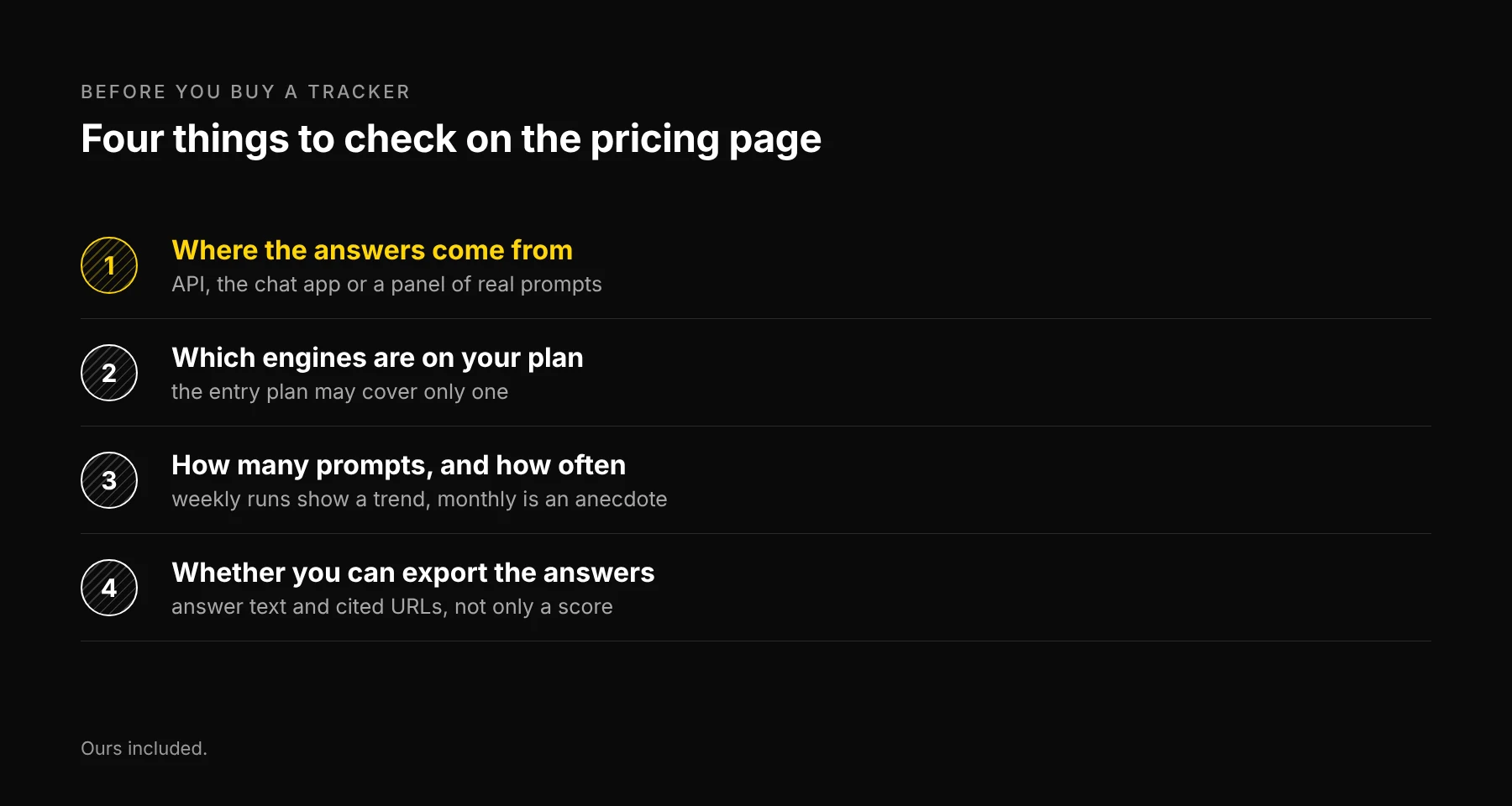
- Where the answers come from. A tracker can query an engine's API, drive the consumer chat app, or buy a panel of real user prompts. These are different measurements: an API answer can differ from what a signed-in user sees in the app. So two trackers can disagree about the same brand, and both can be right.
- Which engines are on your plan. "Tracks ChatGPT, Perplexity and Gemini" on the pricing page can mean one of them on the entry plan.
- How many prompts, and how often. AI answers change from run to run. Ten prompts a month is an anecdote, and fifty prompts a week is a trend. Price the plan that gives you the trend.
- Whether you can export the answers. A score you can't trace back to the answer text and the cited URLs can't be checked, and you can't act on it.
Once you're reading the numbers, the next questions are about the score itself: what counts as a mention, and whether every zero was actually measured. They're in what an AI visibility score actually measures.
Where to start this week
- Open robots.txt and confirm the AI search bots are allowed on public pages. Ten minutes.
- Confirm your key pages are indexed in Search Console and Bing Webmaster Tools. An afternoon.
- Write down ten prompts a buyer would type about your category, and run them by hand in ChatGPT, Perplexity and Gemini. Note who gets named. One hour, and it tells you whether you need a tracker at all.
- If you do, take the four checks above to two trackers and compare the answers.
Our manual AI visibility audit has the spreadsheet for step 3.
Frequently asked questions

Written by
Jose Antonio Mijares
SEO & GEO Expert | Founder at Ezeo