
Key Takeaways
- An AI visibility score is a summary of how often AI assistants mention or cite your brand across a set of prompts. It is only as meaningful as the prompts, the surfaces and the checks behind it.
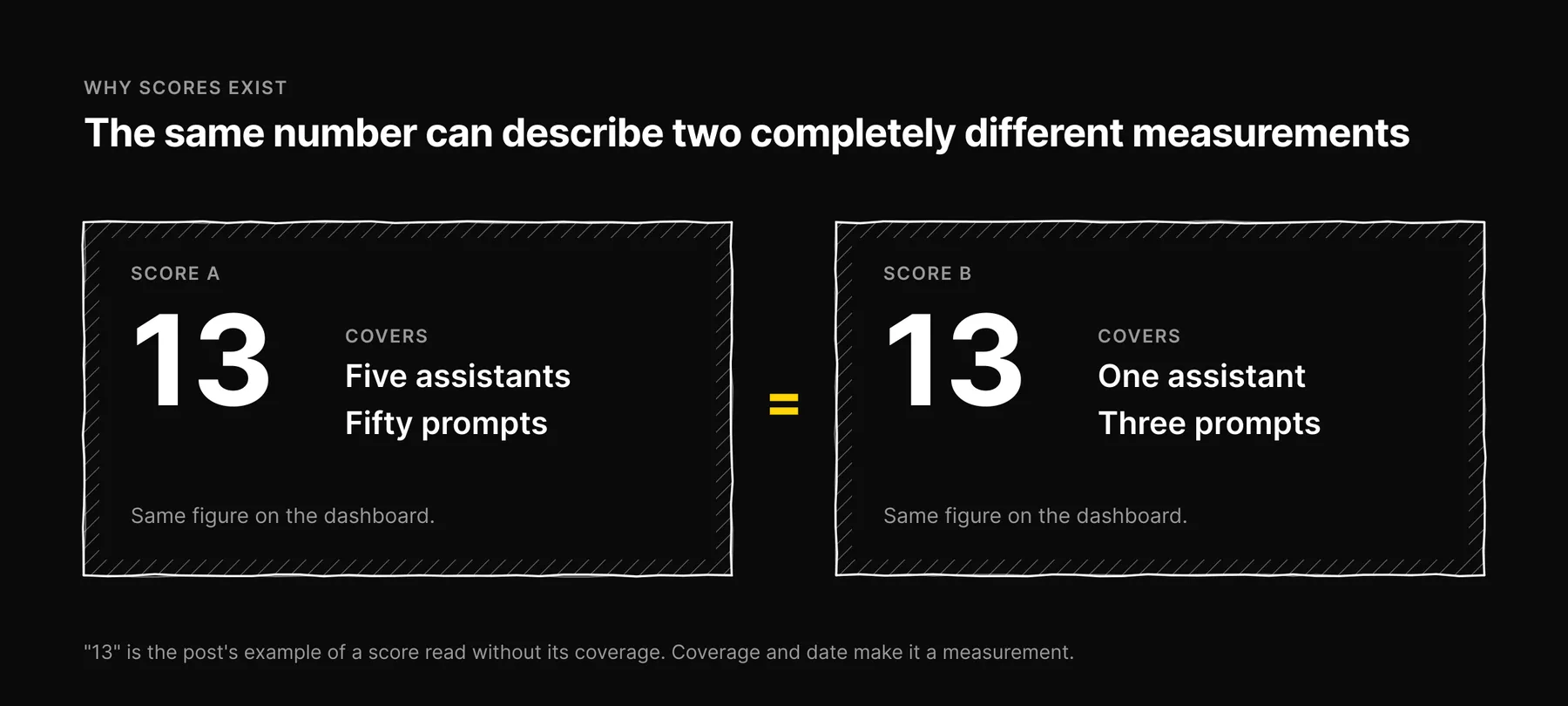
- Two scores with the same number can describe completely different things: one might cover five assistants and fifty prompts, the other one assistant and three prompts.
- The most common error is a zero that was never measured. If a surface was not queried, the score must say so rather than count it as absent.
- Ask six questions before you trust any score: which surfaces, which prompts, mention or citation, measured or default, when, and comparable to what.
- A useful score comes with its coverage and its date. Without them it is a number, not a measurement.
Definition: An AI visibility score is a single figure that summarizes how often a brand appears, by name or as a cited source, in answers generated by AI assistants such as ChatGPT, Claude, Gemini, Perplexity and Google AI Overviews, over a defined set of prompts and a defined period.
Why AI Visibility Scores Exist
Buyers now ask assistants for recommendations, and those answers do not show up in the tools marketers already use. A rank tracker tells you where a page sits on Google. It cannot tell you whether ChatGPT named you when someone asked for the best option in your category. Search Console records impressions and clicks. It cannot record a recommendation that produced no click.
A visibility score tries to fill that gap with one number you can track week to week. That is a reasonable goal. The problem is that a single number hides every decision that produced it, and in AI visibility those decisions change the answer more than your content does.
What Goes Into an AI Visibility Score?
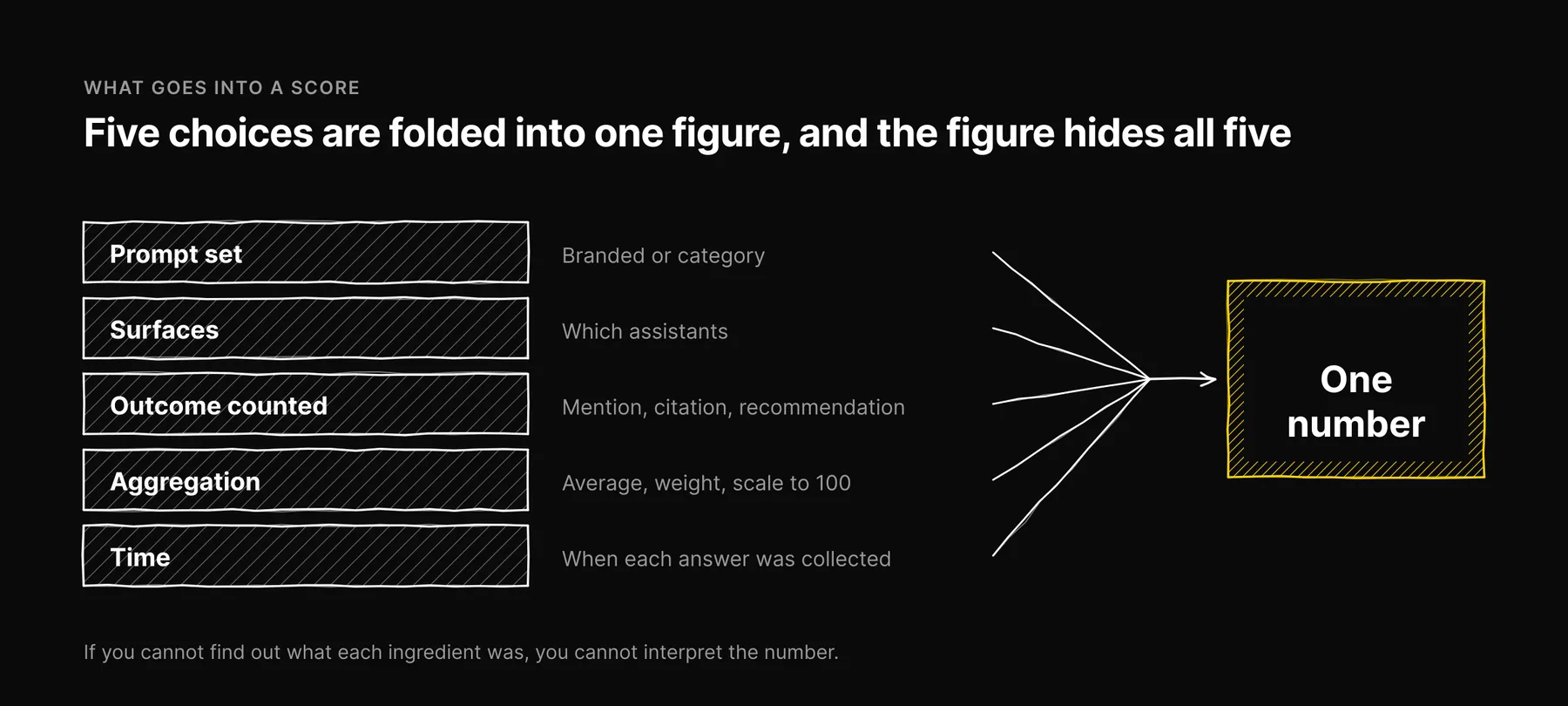
Every score, whatever a vendor calls it, is built from the same five ingredients. If you cannot find out what each one was, you cannot interpret the number.
| Ingredient | What it is | Why it changes the score |
|---|---|---|
| Prompt set | The questions sent to each assistant | Branded prompts ("is Ezeo good") inflate scores; category prompts ("best AI visibility tool") are the ones that matter |
| Surfaces | Which assistants were queried | Assistants disagree often; a score from one surface says nothing about the others |
| Outcome counted | Mention, citation, recommendation, or position in the answer | A brand can be mentioned without being cited, and cited without being recommended |
| Aggregation | How results are combined into one figure | Averaging across surfaces, weighting by prompt volume, or scaling to 100 all produce different numbers from the same raw data |
| Time | When each answer was collected | Models update without notice; an undated result becomes a present-tense claim as it ages |
Mention, Citation and Recommendation Are Different Outcomes
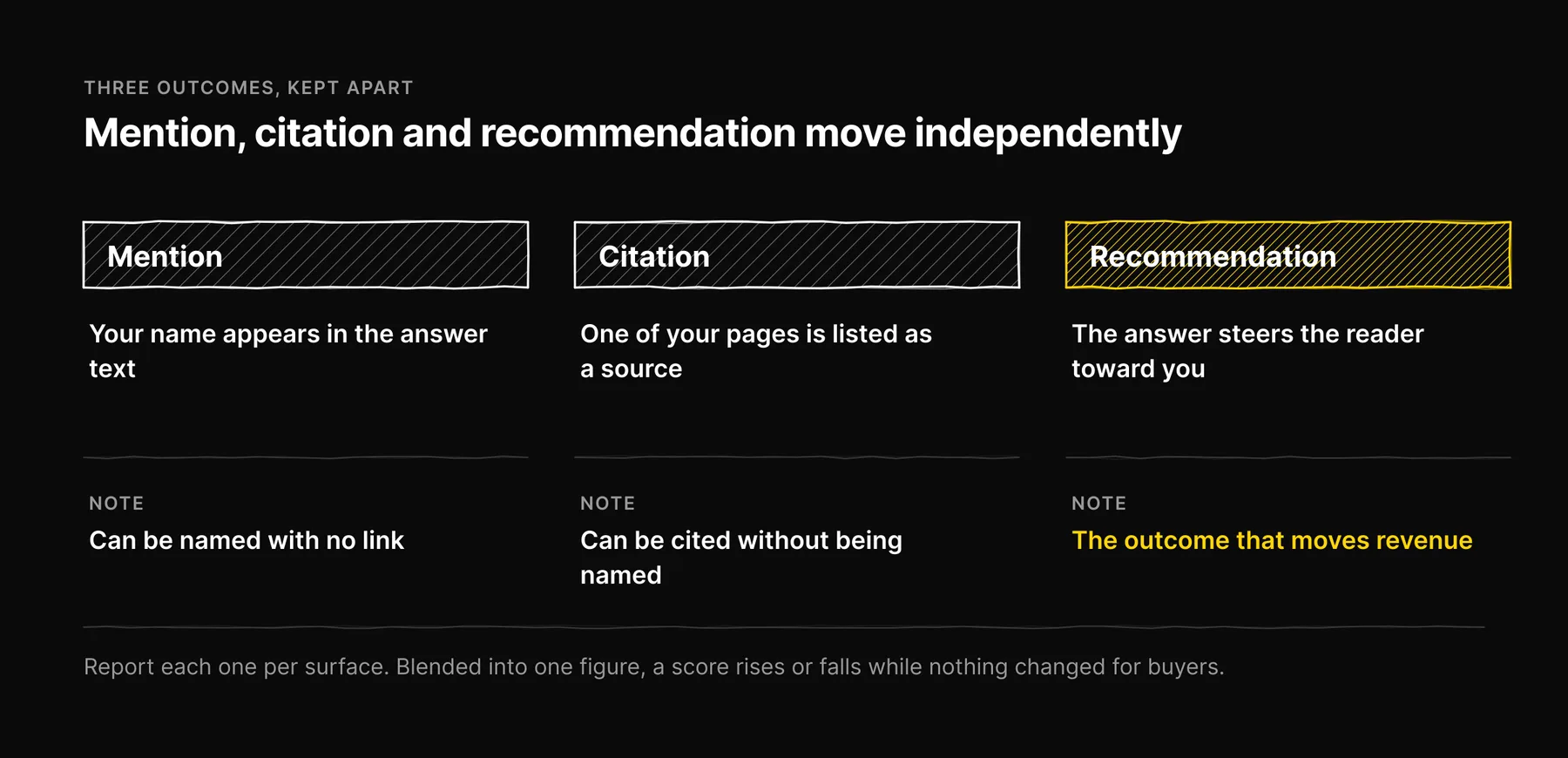
These three are often blended into one "visibility" figure, and they should not be.
- A mention is your brand's name appearing in the answer text. "Tools in this category include Ezeo, A and B" is a mention.
- A citation is one of your pages being linked or listed as a source for the answer. Perplexity's numbered sources and Google AI Overviews' source cards are citations. You can be cited without being named, if the engine used your guide to explain a concept.
- A recommendation is the answer steering the reader toward you. "For Shopify stores, Ezeo is the better fit" is a recommendation. It is the outcome that moves revenue, and the hardest one to measure consistently, because it needs someone, or something, to read the answer's intent.
A score that counts all three as one number will rise when you get cited in an educational answer and fall when you get named but not linked, even if nothing changed in how buyers see you. Keep them apart, and report each per surface.
Six Questions to Ask Before You Trust a Score
1. Which surfaces were actually checked, this run?
Not which surfaces the product supports: which ones returned an answer for this specific run. Checks fail. APIs time out, a provider rejects a request, a surface is switched off to save cost. If a run only reached two of five assistants, a score that averages five is averaging three blanks.
2. Which prompts, and who wrote them?
Ask to see the prompt list. Check how many are branded, how many are category questions, and whether they sound like something a buyer would type. A score built mostly on prompts that include your brand name measures whether the assistant knows you exist, not whether it would choose you.
3. Is it counting mentions, citations or recommendations?
See the previous section. If the answer is "all of them, combined", ask for the breakdown.
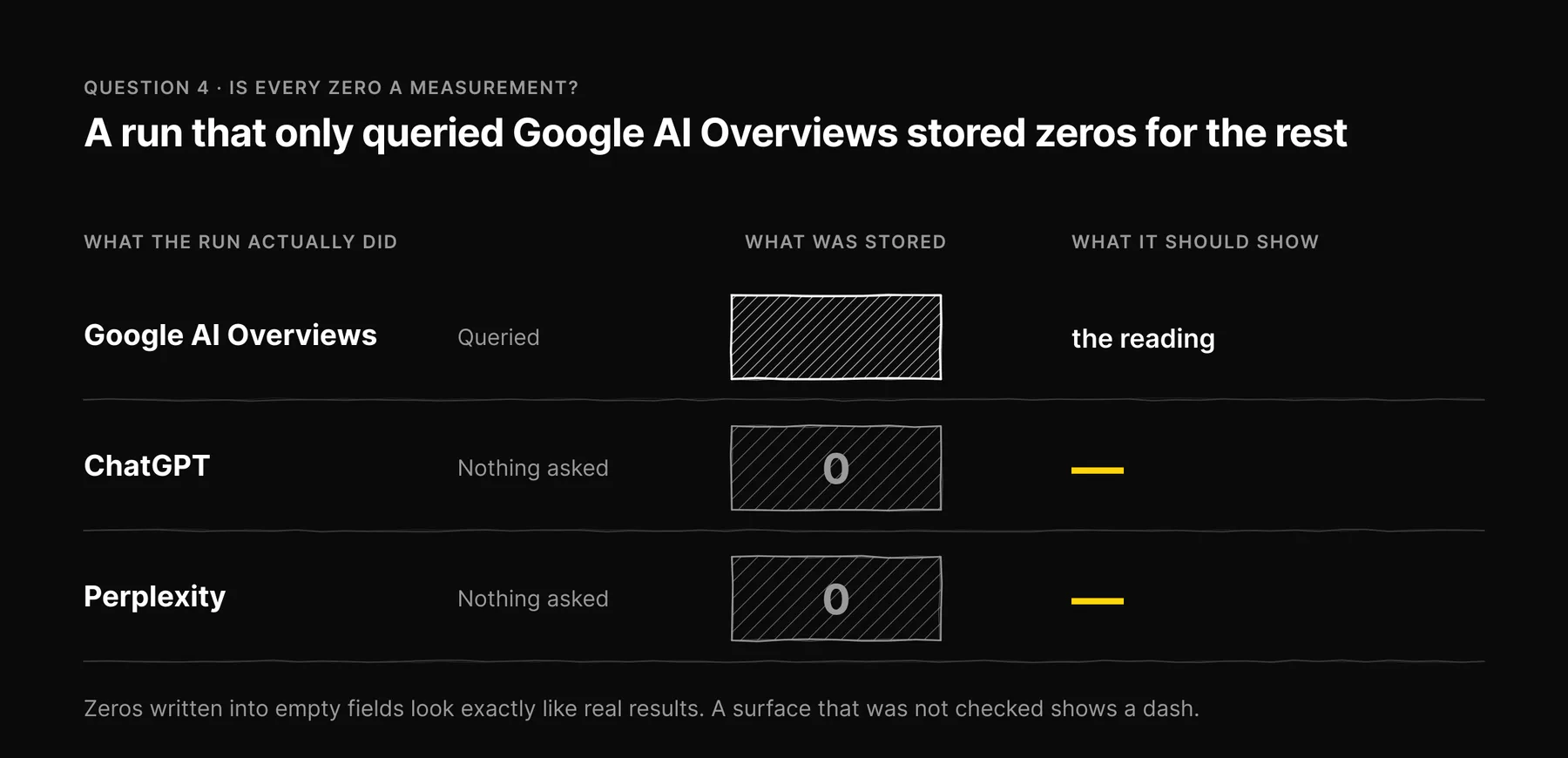
4. Is every zero a measurement?
This is the question almost nobody asks, and it is the one we got wrong ourselves. When we reviewed the AI visibility checks on Ezeo's own project, we found runs that had only queried Google AI Overviews still storing a zero for ChatGPT and a zero for Perplexity. Nothing had asked either assistant anything. The zeros were defaults written into empty fields, and they looked exactly like real results.
A zero is the most dangerous value in any report, because "we checked and found nothing" and "we never checked" print identically. A trustworthy score either leaves an unmeasured surface out, or shows it as not measured. It never counts it as absence.
5. When was each answer collected?
A score updated "weekly" can still be built from answers that are weeks old if some checks failed and the last good value was carried forward. Look for a date on each surface, not just on the report.
6. Is this week comparable to last week?
If the prompt set changed, the surfaces changed, or the scoring formula changed, the trend line is comparing different things. Movement you see may be the method moving, not your brand. A sound tool tells you when the basis of a comparison changed.
Why Scores Move When Nothing Changed
Even with a fixed method, expect noise. AI assistants do not return the same answer to the same prompt every time. Answers vary with the model version, the retrieval results of the moment, and sometimes the phrasing of a follow-up. That has three practical consequences:
- One run is a data point, not a trend. Judge direction over several runs.
- Small prompt sets swing hard. With five prompts, one answer changing moves a surface by 20 percentage points. With fifty, it moves by two.
- Model updates are events. When a surface's behavior shifts across every prompt at once, suspect the model, not your content, and note the date.
How to Calculate a Score You Can Defend
You do not need a vendor to start. A spreadsheet and an afternoon will give you a baseline you understand completely.
- Write the prompt set. Twenty to fifty buyer questions for your category, plus five that name your brand, kept on a separate tab.
- Query each surface. ChatGPT, Claude, Gemini, Perplexity and Google (for AI Overviews, note whether one appeared at all).
- Record three columns per answer: mentioned (yes/no), cited (yes/no, with the URL), recommended (yes/no). Add the date and the surface.
- Calculate per surface: mention rate = prompts where you were mentioned ÷ prompts that returned an answer on that surface. Same for citation rate.
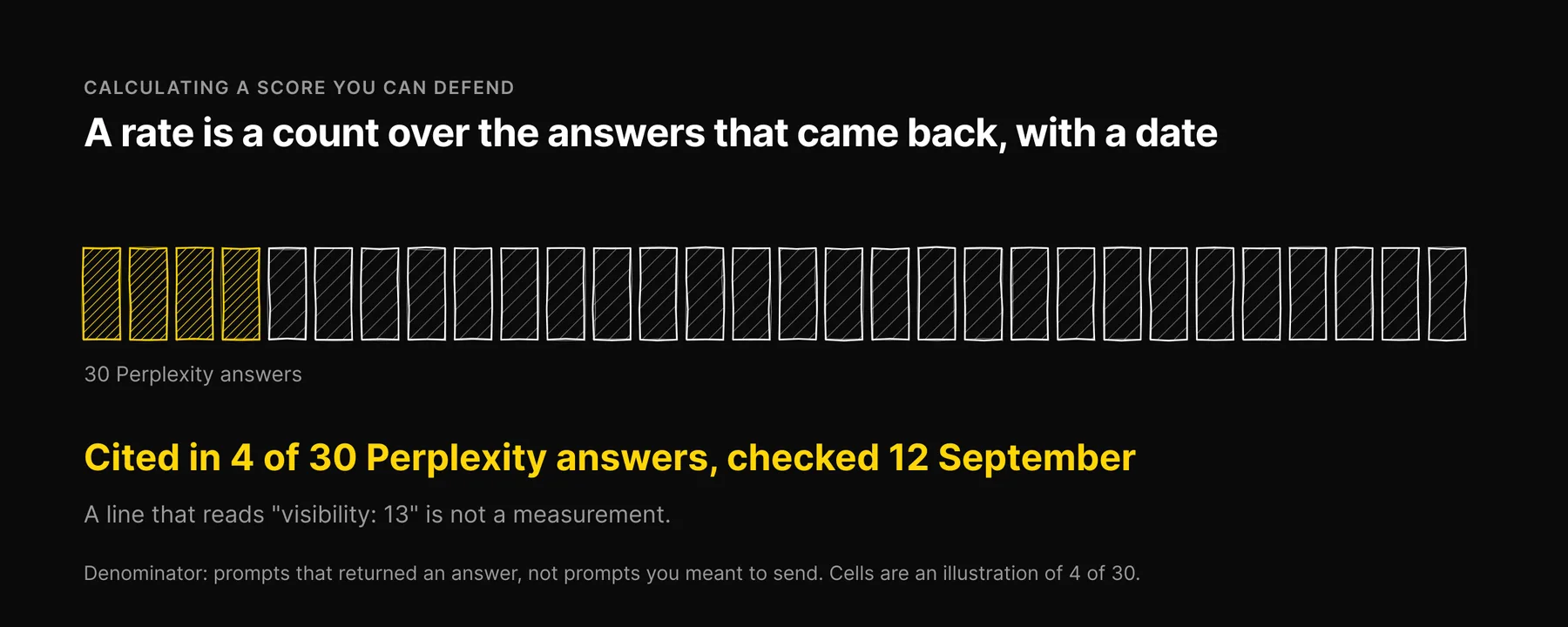
- Report coverage beside the rate. A line that reads like "cited in 4 of 30 Perplexity answers, checked 12 September" is a measurement. A line that reads "visibility: 13" is not.
- Only then, if you need one number, average the surfaces you actually checked, and state which ones they were.
Note the denominator in step four: prompts that returned an answer, not prompts you meant to send. If a surface failed for half the prompts, your rate is over the half that worked, and the other half is reported as not measured.
How Ezeo Reports AI Visibility
We built Ezeo around one rule: a number is a measurement, or we don't show it. For AI visibility that means:
- Five named surfaces, reported separately: ChatGPT, Claude, Gemini, Perplexity and Google AI Overviews.
- Every result dated with when it was measured, and every run stored, so a trend is a series of real readings rather than a line drawn between two.
- Absence shown as absence. A surface that was not checked shows a dash, not a zero, and the report says which surfaces a figure covers.
- Visibility beside the rest of search. AI answers sit next to your Google rankings, Search Console and analytics, so you can see whether a page that ranks is also the page assistants quote.
We publish our own figures on the Ezeo home page, including the ones that are not flattering. At the last reading, our own brand had been cited zero times across 19 completed checks on four surfaces, and two surfaces had never been checked at all. We say that because it is true, and because a tool that would hide our own zero would hide yours.
What a Good Score Report Looks Like
Whether you use Ezeo, another platform or a spreadsheet, a report you can act on has these properties:
- A rate per surface, with the number of prompts behind it.
- Mentions, citations and recommendations shown separately.
- The date each surface was last measured.
- Unmeasured surfaces labelled as such.
- The competitors named in the same answers, so you can see who is winning the questions you are losing.
- The specific prompts where you are absent, because those are your to-do list.
The last point is the reason to measure at all. A visibility score is a thermometer. The prompts where a competitor is named and you are not are the diagnosis. For what to do about them, start with our guide to answer engine optimization and our checklist of the content quality signals AI models look for.
Frequently asked questions

Written by
Jose Antonio Mijares
SEO & GEO Expert | Founder at Ezeo