
Key Takeaways
- Answer engine optimization (AEO) is the work of making your pages the source an AI assistant or search feature quotes when it answers a question directly.
- AEO, GEO and "AI SEO" describe overlapping work. The useful distinction is not the label but the outcome you measure: a click, a mention, or a citation.
- Answer engines reward pages that answer one question per section, in the first two or three sentences, with facts they can check elsewhere.
- You cannot manage AEO from a rank tracker. A page in position one on Google tells you nothing about whether ChatGPT names you.
- Measure it per surface, per prompt, with a date on every result, and never let "we didn't check" turn into a zero.
Definition: Answer engine optimization (AEO) is the practice of structuring content, technical signals and brand facts so that answer engines such as ChatGPT, Perplexity, Gemini, Claude and Google AI Overviews select your page as the source of a direct answer, and name your brand in it.
What Is Answer Engine Optimization?
Answer engine optimization is search optimization for the moment the searcher stops clicking. A classic search result hands the reader ten links and lets them choose. An answer engine reads those pages on the reader's behalf, writes one answer, and names a handful of sources. If your page is one of them, you are part of the answer. If it is not, you are invisible to that buyer, even if you rank well.
The term is older than ChatGPT. It grew up around featured snippets and voice assistants, where one spoken answer replaced a page of results. What changed in the last two years is scale. Google began showing AI Overviews in the United States in May 2024, and buyers now ask assistants for recommendations directly: "what's the best tool for tracking AI visibility", "which gutter vacuum works on a two-storey house". The assistant answers, names a few brands, and the search is over.
That is why we treat AEO as a measurement problem first and a writing problem second. You can only improve what you can see, and most reporting stacks cannot see an answer at all.
AEO vs SEO vs GEO: What Is the Difference?
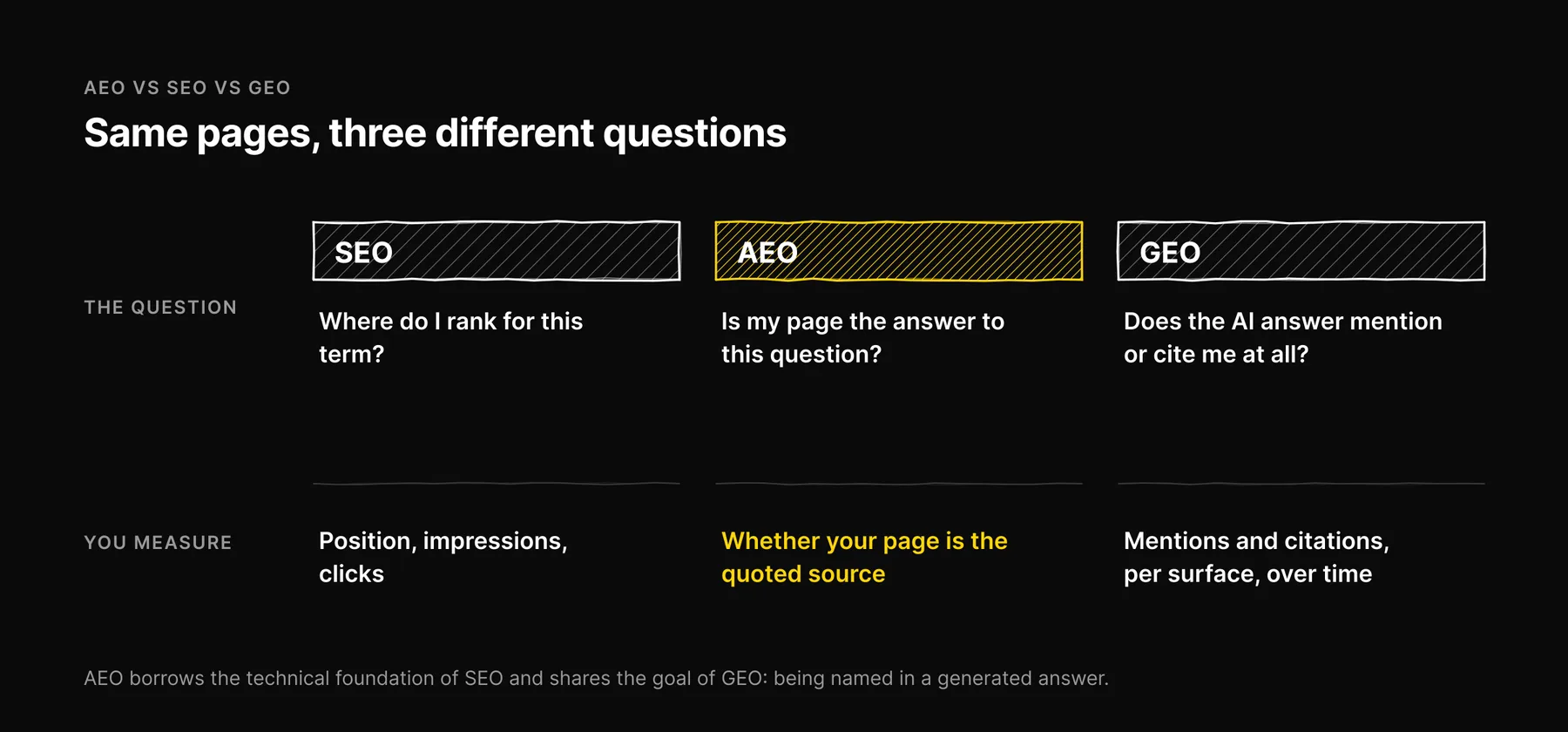
The three labels overlap more than vendors like to admit. Here is the distinction we use at Ezeo, based on what each one is trying to win.
| SEO | AEO | GEO | |
|---|---|---|---|
| The question it answers | Where do I rank for this term? | Is my page the answer to this question? | Does the AI answer mention or cite me at all? |
| Where it plays | Ten blue links | Featured snippets, AI Overviews, voice and assistant answers | Generated answers in ChatGPT, Claude, Gemini, Perplexity and Google AI Overviews |
| What you measure | Position, impressions, clicks | Whether your page is the quoted source | Mentions and citations, per surface, over time |
| Main levers | Relevance, links, technical health | Answer-first structure, question coverage, schema | Entity clarity, corroboration, citable facts |
In practice AEO sits between the other two. It borrows SEO's technical foundation, because an engine that cannot crawl you cannot quote you, and it shares GEO's goal of being named in a generated answer. If you are already doing SEO and GEO together, AEO is mostly a discipline about how each page is written.
How Do Answer Engines Choose an Answer?
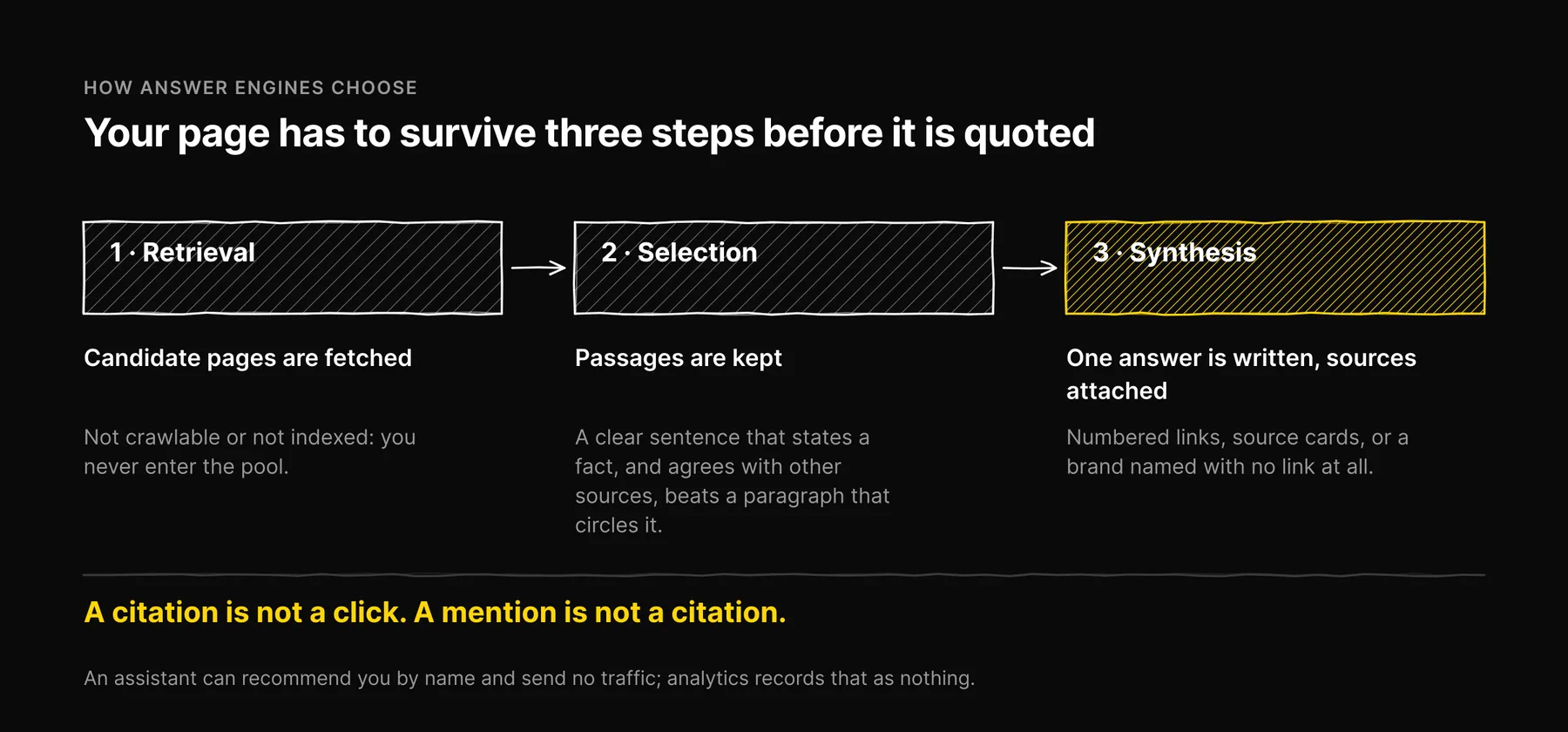
Every assistant works differently, and none publishes its selection rules. What we can observe from running the same prompts across five surfaces is a common shape with three steps.
- Retrieval. Engines that search the live web (Perplexity, ChatGPT with search, Gemini, Google AI Overviews) first fetch a set of candidate pages. If your page is not crawlable, or not indexed, it never enters the pool. Answers without live search draw on what the model learned in training, which you cannot change quickly.
- Selection. From that pool, the engine keeps passages that answer the question directly and that agree with other sources. A clear sentence that states a fact beats a paragraph that circles it.
- Synthesis. The engine writes its own answer and attaches sources. Perplexity shows numbered links, Google AI Overviews shows source cards, and a chat assistant may name a brand without linking to anything.
That last step matters for measurement. A citation is not a click, and a mention is not a citation. An assistant can recommend you by name and send no traffic at all. Your analytics will record that recommendation as nothing.
The AEO Playbook: Eight Steps That Work
1. Build a question inventory from real demand
Start with the questions buyers already ask. Your own Search Console queries are the best source, because they are questions people used to find you. Filter for queries that start with how, what, which, why, best and vs, then add the questions your sales and support teams hear every week. Group them by the page that should answer them. One page, one cluster of closely related questions.
2. Answer first, then explain
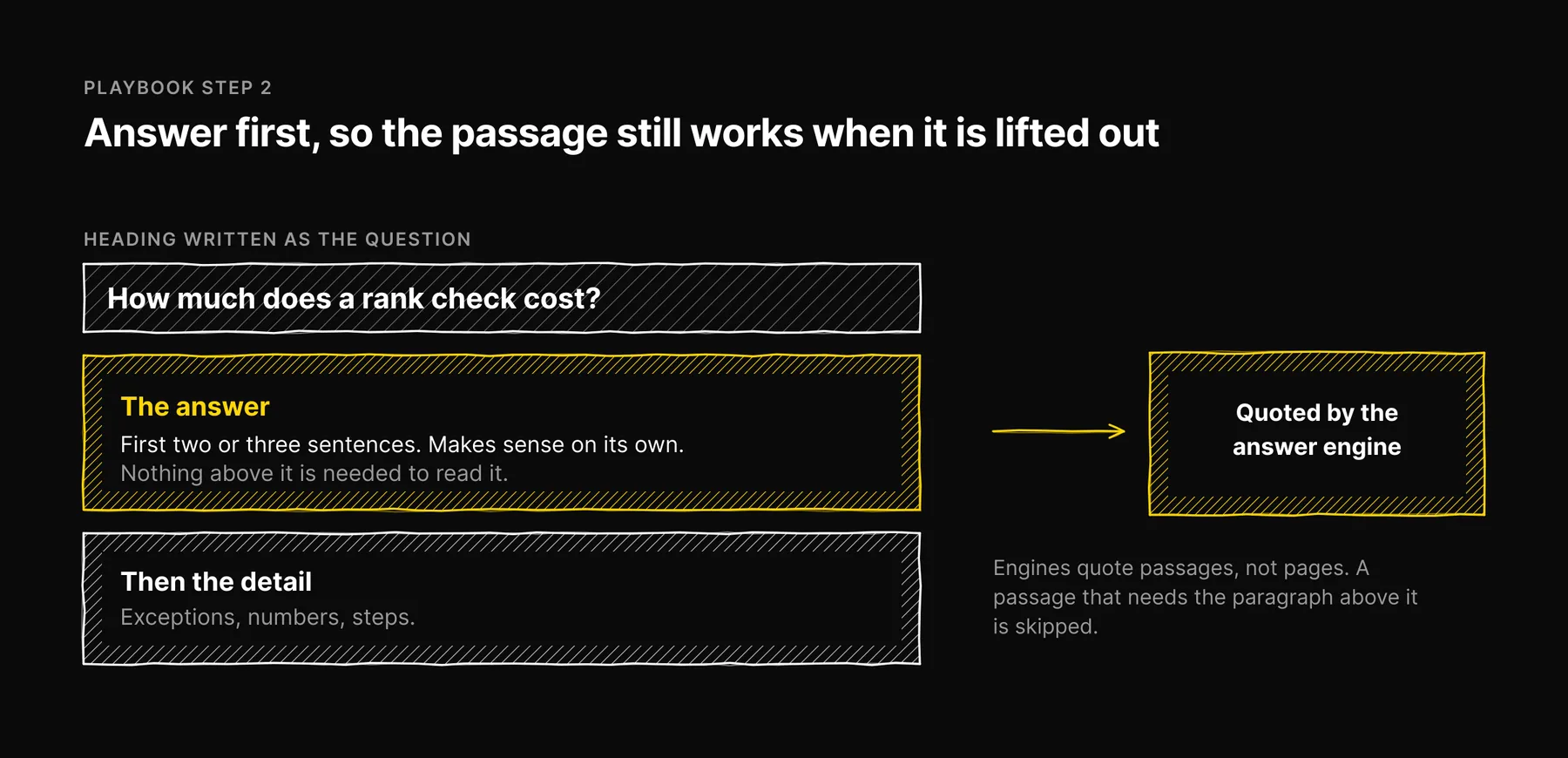
Put the answer in the first two or three sentences under each heading, written so it still makes sense if it is lifted out on its own. Then add the detail: the exceptions, the numbers, the steps. Answer engines quote passages, not pages, and a passage that needs the paragraph above it to make sense is a passage they skip.
3. Write headings as the questions people ask
"How much does a rank check cost?" is a better heading than "Pricing considerations". It matches the prompt, it tells the engine exactly what the section answers, and it gives a reader skimming the page the same shortcut.
4. Use structure an engine can lift
Comparison tables, numbered steps and short definition blocks are easy to quote accurately. Build tables in HTML, not as images. Keep one idea per list item. If you compare products or plans, put the attributes in rows so each cell is a checkable fact.
5. Make your brand facts consistent everywhere
Engines cross-check. If your pricing page says one thing, an old blog post says another, and a review site says a third, you have given the engine a reason to leave you out or to quote the wrong figure. Pick one canonical wording for what you are, who you serve, what you cost and what you do not do, and use it on your site, your profiles and your listings.
We learned how easily this breaks in our own content pipeline. A price that was correct when a product sheet was captured can be out of date by the time an article that quotes it is published, and it will pass every automated check along the way. Facts need a refresh date, not just a source.
6. Add the schema that describes what the page is
Structured data will not make a weak page an answer, but it removes ambiguity about what the page contains. Use Article or BlogPosting with a real author and dates, Organization on your home page, Product with price and availability on product pages, and BreadcrumbList for hierarchy. FAQPage markup is still valid structured data, although Google limited FAQ rich results to a small set of authoritative sites in 2023, so do not add it expecting a visual change in Google results.
Check the output, not the template. We found markdown links leaking into the plain-text answer field of FAQ schema on generated articles: every entry looked fine on the page and carried literal [brackets](https://…) in the markup. Only reading the rendered JSON-LD caught it.
7. Let the right crawlers in
Check your robots.txt and your CDN or firewall rules for the crawlers answer engines use. The search-time crawlers are the ones that decide whether you can be cited today: OAI-SearchBot and ChatGPT-User for ChatGPT, PerplexityBot for Perplexity, and Googlebot for AI Overviews. Training crawlers such as GPTBot, ClaudeBot and the Google-Extended token are a separate decision about model training. Blocking Google-Extended does not remove you from Google Search or AI Overviews, so decide each one on purpose rather than with a blanket rule.
A short llms.txt file at your root is cheap to add and gives assistants a curated map of your most important pages.
8. Earn corroboration off your own site
An answer engine trusts a claim more when independent sources agree with it. That means reviews on the platforms your buyers use, mentions in trade publications, honest comparisons that include you, and discussions in communities where your category is argued about. You cannot fake this, and you should not try. You can make sure the facts other people repeat about you are accurate, by publishing them clearly first.
How Do You Measure Answer Engine Optimization?
This is where most AEO programs quietly fail. The work is easy to describe and hard to see, so teams report activity instead of outcome. A sound measurement setup has five parts.
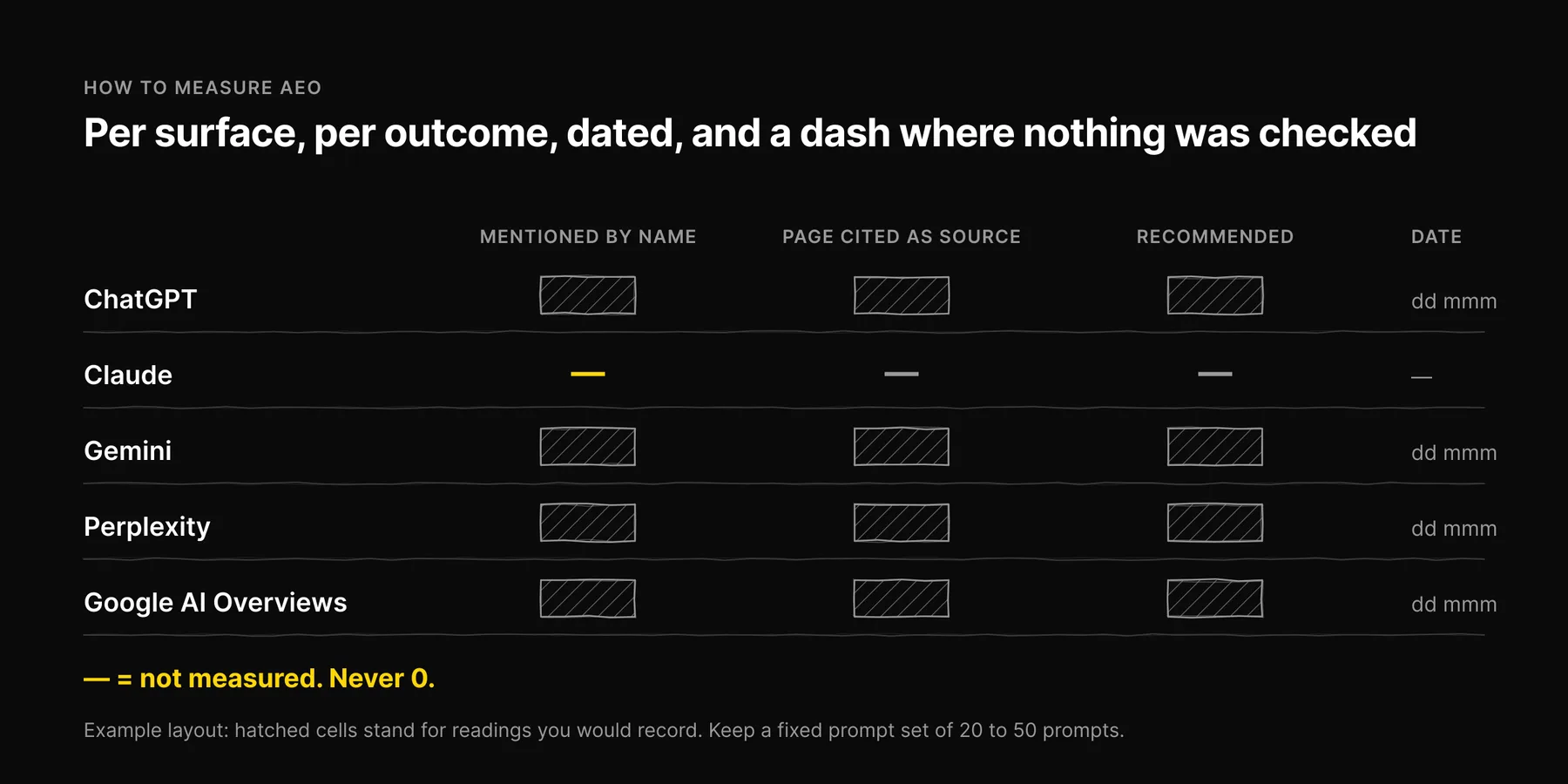
- A fixed prompt set. Write 20 to 50 prompts that a real buyer would type, in their words, not yours. Keep them stable so results are comparable over time. Add new prompts as new rows, never by editing old ones.
- Named surfaces. Record results separately for ChatGPT, Claude, Gemini, Perplexity and Google AI Overviews. They disagree often, and an average across them hides the one where you are missing.
- Three outcomes, kept apart. Were you mentioned by name? Was one of your pages cited as a source? Did the answer recommend you? These move independently.
- A date on every result. Answers change when models update. A result without a date becomes a present-tense claim the moment it ages.
- An honest zero. "We checked and you were not there" and "we did not check" must never look the same. If a surface was not queried this run, record it as not measured, not as zero.
We hold ourselves to the same rule. Ezeo's own project had been cited zero times across 19 completed checks between 17 May and 9 August 2026, and when we reviewed those rows we found checks that had only queried Google AI Overviews still carrying zeros for ChatGPT and Perplexity. Those zeros were defaults, not findings. We now show a surface we did not check as a dash, and we publish our own numbers on our home page with the date they were read.
We are also starting from the bottom on the phrase this article is about. As of September 2026 our tracked keyword "answer engine optimization" does not appear in Google's top 100 results for ezeo.ai. This guide is our first move on it, and we will report what it does.
Common AEO Mistakes
- Writing for the engine instead of the reader. Stuffing every People Also Ask phrasing into a page makes it worse for humans and no better for engines, which reward clarity over coverage.
- Burying the answer. A 200-word introduction before the first useful sentence is the most common reason a good page is not quoted.
- Treating a single run as a trend. Assistants are not deterministic. One answer that names you, or one that does not, is a data point, not a result.
- Reporting an average score with no coverage. A visibility score that blends surfaces you checked with surfaces you did not is measuring your setup, not your brand. Read what an AI visibility score actually measures before you trust one.
- Letting facts go stale. Prices, plans, specs and availability change. An answer engine will happily quote last quarter's price from your own blog.
Where to Start This Week
Pick the ten questions that matter most to your revenue. For each, find the page that should answer it, rewrite its opening so the answer comes first, and check that the facts match your pricing and product pages. Then ask those ten questions on each of the five surfaces, write down who was named and cited, and put today's date next to every answer. That spreadsheet is your AEO baseline. Everything after it is measured against it.
If you would rather not run that sweep by hand, that is what Ezeo does: it asks ChatGPT, Claude, Gemini, Perplexity and Google AI Overviews the questions your buyers ask, keeps each answer with the date it was measured, and puts it beside your rankings and traffic. You can book a call to see it on your own brand.
Frequently asked questions

Written by
Jose Antonio Mijares
SEO & GEO Expert | Founder at Ezeo